← All services


27 European companies
Loan Servicing Providers in Europe
Loan servicing platforms manage the ongoing administration of loans after origination — processing repayments, calculating interest, managing arrears, issuing statements, and handling the full lifecycle through to final repayment or default. Efficient loan servicing is operationally critical for lending businesses at scale, where manual processes quickly become unmanageable as portfolio volumes grow.
Typically offered by
European fintech companies offering loan servicing
Monzo
Wealth🇬🇧 United Kingdom
The founding team that built Monzo had all worked together before — at Starling Bank, another challenger startup that didn't survive its internal conflicts. Tom Blomfield, Gary Dolman, Jonas Huckestein, Jason Bates, and Paul Rippon left together in 2015 and started again. The product was initially a prepaid card — a coral-coloured piece of plastic that became one of the most recognisable objects in British fintech — before becoming a fully licensed current account in 2017. The early community was unusual for a bank: public engineering blogs, user forums, beta programmes, and a 2016 crowdfunding round that raised £1 million in 96 seconds, a world record. People felt ownership of the product in a way no high street bank had ever achieved, and that emotional connection became a durable competitive advantage.
A decade on, the results have caught up with the mythology. For the year to March 2026, Monzo reported revenue of £1.71 billion, up 39%, with gross profit crossing £1 billion for the first time and a third consecutive year in the black — statutory pre-tax profit of £87.3 million, up 44%, or £172.6 million adjusted for restructuring charges and a roughly £21 million FCA fine over historical financial-crime control failings. The bank added a record three million customers to reach 15.2 million — one in five UK adults — with deposits up 55% to £25.7 billion, 1.6 million paying subscribers, and business banking growing 45% to 905,000 customers and 14% of revenue. Four separate income streams — current account balances, borrowing, payments, and wealth — each now clear £300 million. Half of active customers use Monzo as their primary bank, which shows up in the metric that anchors every valuation conversation: revenue per active personal customer of £167, against Revolut's £66. The gap is the difference between being someone's bank and being their travel card.
Leadership and strategy both turned over during the year. Diana Layfield, a former Google executive, took over as CEO in February 2026 following TS Anil's departure — a transition shaped in part by board tensions over IPO venue and the company's UK concentration. Her first significant moves were decisive: Monzo closed its US operations entirely, and redirected the international ambition at Europe, where it secured a banking licence from the Central Bank of Ireland, launched in Ireland to a 100,000-person waitlist, and named Spain as the next market. The acquisition of digital mortgage broker Habito completed on 1 April 2026, giving the bank a capital-efficient route into mortgages — a product more than 550,000 customers were already tracking in the app. Costs rose with the ambition: the cost-to-income ratio ticked up to 74% as hiring and marketing accelerated.
Monzo remains private, valued at approximately $5.9 billion in its 2024 secondary sale, and Layfield has told the FT she is "not in a hurry" to list. The strategic bet of this chapter is clear and genuinely contestable: that Monzo's deep-relationship, primary-bank model — expensive to build, lucrative per customer — can be exported to European markets where Revolut arrived a decade earlier with the opposite playbook. The UK numbers say the model works. Europe will say whether it travels.
Founded 2015
Lendable
Capital Markets🇬🇧 United Kingdom
Lendable is the most valuable European fintech most consumers have never heard of, which is partly by design. Martin Kissinger — German-born, LSE and Oxford, an entrepreneur-in-residence at Rocket Internet before founding his own company — started it in London in 2014 with Victoria van Lennep, Paul Pamment, and Jakob Schwarz, in the dying days of the peer-to-peer lending era. The insight that outlived P2P was structural: don't hold loans on your own balance sheet and don't take retail money — aggregate institutional capital from pension funds and hedge funds, and compete purely on underwriting. Lendable's machine-learning models automate credit decisions end to end, approving personal loans in seconds, and the company takes fees for origination and servicing while the institutions take the credit risk. Asset-light, capital-efficient, and — unusually for the category — profitable early and quietly, a combination that had Sifted profiling it as one of Europe's most secretive fintechs back in 2020.
The quiet ended with the numbers. Revenue jumped 90% to £446 million in 2025 with profits more than doubling, and Experian data showed Lendable issued more new consumer credit loans by volume than any other UK lender that year — any bank included — while ranking second in new credit cards issued. A twelve-year-old company with 643 employees out-originating institutions with balance sheets a hundred times its size is the clearest available evidence that consumer credit underwriting is now a data and automation problem, not a branch-network problem. The product range has widened from personal loans into credit cards and car finance, and in July 2026 the company priced its debut public securitisation — a £500 million deal backed by UK personal loans under the Hoxton Consumer Loan Funding programme — opening a cheaper, deeper funding channel alongside its institutional partnerships.
The capital story has been correspondingly disciplined: roughly $290 million in equity across its history, a £210 million round led by Ontario Teachers' Pension Plan in March 2022 valuing the company at £3.5 billion, and Goldman Sachs among the backers. The valuation hasn't been retested publicly since — which cuts both ways in a repriced fintech market — and the IPO question follows Lendable around as persistently as it follows Monzo, with nothing filed. Expansion is the current chapter: the US operation established in 2021 is where profits are being reinvested, with Mexico planned next. Kissinger's thesis for why a lender travels better than a neobank is worth noting — personal loans and credit cards are structurally similar across markets, while current-account propositions are deeply local.
The honest caveat is the one that applies to every consumer lender that has only grown: Lendable's model has been profitable through a decade that included a pandemic and a rate shock, but unsecured consumer credit is cyclical, and an originator whose volumes now lead the UK market carries UK household credit exposure at scale — mediated to institutional investors, but reputationally and operationally its own. The machine has out-underwritten the banks in benign and bumpy conditions alike; a genuine credit downturn remains the test that separates good models from lucky ones.
Founded 2013
Mambu
Financial Infrastructure🇩🇪 Germany
Mambu is a cloud-native banking software platform that lets financial institutions and fintechs launch and operate lending and deposit products without building from scratch. Rather than forcing customers into rigid legacy systems, Mambu provides composable banking infrastructure—modular APIs and pre-built components that work together or stand alone, depending on what you actually need.
The company sits at the intersection of two fintech realities: traditional banks are drowning in outdated core systems that can't keep pace with market demands, while new lenders and neobanks need speed without sacrificing compliance or scale. Mambu's approach is to be the operating system underneath, handling the heavy lifting of loan origination, deposit management, portfolio servicing, and regulatory reporting while letting clients focus on customer experience and product innovation.
What makes Mambu different from other core banking platforms is its emphasis on velocity. Institutions deploy in weeks rather than years. The platform is genuinely modular—you can pick the lending module, the deposit module, or both, and layer in third-party services through APIs. This flexibility has resonated with everyone from African microfinance networks to European challenger banks to enterprise lenders managing complex credit products.
Mambu is now a critical piece of infrastructure in the emerging markets fintech ecosystem, particularly across Africa and Asia, where it powers lending operations for hundreds of financial institutions. In Europe, it's carved out space among mid-market and challenger banks looking to avoid the capital expenditure and technical debt of legacy systems. The company represents a broader shift in fintech: away from end-to-end platforms that claim to do everything, toward specialized infrastructure that does one thing—backend financial operations—exceptionally well.
Founded 2011
Narvi
Embedded Finance🇫🇮 Finland
Narvi is a European fintech that simplifies embedded lending for e-commerce and marketplace platforms. Rather than forcing merchants to build lending infrastructure from scratch, Narvi handles the entire loan lifecycle—from origination through servicing—as a white-label API that integrates directly into checkout flows.
The company targets online retailers and marketplace operators who want to offer buy-now-pay-later and installment credit without the operational overhead of underwriting, collections, or compliance. Narvi handles credit decisions using proprietary scoring models and manages all regulatory requirements, while merchants simply embed a widget and capture incremental revenue.
In a market crowded with point-solution BNPL providers, Narvi positions itself as a full-stack lending partner rather than a payment mode. The company serves merchants across Europe and has built integrations with major e-commerce platforms, making it simpler for smaller retailers to compete with well-funded rivals on financing offerings.
Narvi represents a growing class of embedded finance infrastructure plays—companies enabling non-financial businesses to offer financial products without becoming financial institutions themselves. Its role is to abstract complexity and regulatory burden, letting merchants focus on customer experience and growth.
Founded 2020
Zopa
Lending🇬🇧 United Kingdom
Zopa rewrote the lending playbook by putting people before profit margins. Founded in 2005, it was the original peer-to-peer lending platform in the UK—a marketplace where ordinary people could lend to one another, bypassing the bank middleman entirely. That ethos still runs through everything it does, though the model has evolved considerably.
Today, Zopa operates as a digital lender offering personal loans and credit products directly to consumers, backed by institutional funding rather than peer capital. It's stripped away the complexity traditional lenders love and built something genuinely transparent: you get a real interest rate upfront, no hidden fees, and a lending decision in minutes rather than days. The platform targets people with thin credit histories or subprime scores—segments that banks treat with suspicion and expensive rates.
What separates Zopa from the noise is its refusal to play the conventional credit game. Most lenders obscure terms or rely on manipulative affordability checks. Zopa's approach feels almost quaint by comparison: fair pricing, straightforward underwriting, and a genuine attempt to lend responsibly. It's positioned itself as the anti-bank lender in a market cluttered with me-too fintechs chasing the same high-income borrowers.
In Europe's competitive lending landscape, Zopa represents a maturing fintech that's learned to balance mission with sustainability—proof that there's still room for players who refuse to compromise on transparency.
Founded 2005
4finance
Lending🇱🇻 Latvia
Consumer credit at scale across emerging European markets has been one of the more controversial and one of the larger businesses in European fintech. 4finance was founded in Riga in 2008 and grew into one of the largest digital consumer lenders in Europe, operating in over a dozen markets including Latvia, Lithuania, Poland, Spain, Czech Republic, Slovakia, Romania, Bulgaria, Denmark, Sweden, and beyond. Its product range includes short-term loans, instalment loans, and credit lines, distributed entirely through digital channels. The company's scale — billions in loans originated, millions of customers served — has made it both a significant financial institution and a frequent subject of regulatory and consumer protection scrutiny. The business has navigated the tightening regulation of consumer credit across multiple European jurisdictions, repositioning its product range and pricing as different markets have implemented caps on short-term lending costs. 4finance is owned by funds and operates with the operational scale of a substantial bank without holding traditional banking licences in most of its markets. In the broader European consumer fintech landscape, 4finance represents a category that exists outside the venture-backed startup conversation but processes meaningful credit volume across markets where formal banking remains less accessible than digital alternatives.
Founded 2008
Lendosphere
Lending🇫🇷 France
Lendosphere is a European marketplace lending platform that connects small businesses with institutional investors hungry for alternative returns. Founded on the conviction that traditional banks systematically underserve SMEs, the platform has built a dual-sided network where vetted borrowers access capital at competitive rates while investors diversify beyond bonds and equities. What makes Lendosphere distinct isn't just the marketplace mechanics—it's the emphasis on data-driven credit assessment and a commitment to transparency that appeals to both cautious CFOs and yield-conscious institutional money. The company operates across multiple European markets, handling everything from loan origination through servicing, which means they've had to navigate fragmented regulatory environments while maintaining operational efficiency. In a lending landscape crowded with point solutions and pure-play platforms, Lendosphere positions itself as the connective tissue between supply and demand, enabling capital that would otherwise stay idle or be allocated inefficiently. For SMEs tired of bank gatekeeping, and for institutions seeking uncorrelated returns with human oversight, Lendosphere represents a pragmatic alternative—not utopian blockchain dreams, but boring-boring-good marketplace infrastructure that actually works across borders.
Founded 2014
Assetz Capital
Lending🇬🇧 United Kingdom
Assetz Capital runs a peer-to-peer lending platform that connects individual investors with small and medium-sized businesses seeking growth capital. Rather than routing deals through traditional bank gatekeepers, the platform lets investors browse vetted SME borrowers, assess risk directly, and earn returns by funding loans. It's a middle ground between passive savings accounts and active equity investing, appealing to investors tired of rock-bottom deposit rates and businesses frustrated by bank credit committees.
The platform handles the heavy lifting: borrower vetting, loan servicing, and portfolio management. Investors can diversify across dozens of loans, while businesses get faster access to capital than traditional lenders typically offer. Returns vary by loan grade, giving investors choices between conservative and aggressive lending strategies.
Assetz Capital occupies a distinct niche in the UK fintech landscape. While equity crowdfunding platforms democratize startup investment and traditional banks control the SME lending market, P2P sits in between—offering real asset backing, regulatory oversight, and returns that reflect genuine credit risk rather than venture speculation. It's become a proving ground for how alternative finance can scale without abandoning prudence.
Founded 2013
Scalapay
Embedded Finance🇮🇹 Italy
Scalapay is a BNPL (buy now, pay later) platform built for the European e-commerce market, offering shoppers the ability to split purchases into interest-free instalments at checkout. Rather than simply bolting financing onto existing payment flows, Scalapay positions itself as a full-stack infrastructure play—handling underwriting, risk management, and merchant integration from a single API. The company targets mid-market and enterprise retailers across fashion, electronics, and beauty verticals, regions where instalment purchasing is becoming table stakes for conversion.
What sets Scalapay apart is its focus on merchant flexibility and real-time decision-making. While competitors often impose rigid lending terms or lengthy approval processes, Scalapay emphasizes transparent pricing and instant qualification, allowing merchants to offer financing without friction or hidden costs. The platform integrates seamlessly into checkout experiences—both web and mobile—and provides merchants with detailed analytics on customer behaviour and financing uptake.
Scalapay operates in a crowded BNPL landscape, but differentiates through its emphasis on profitability and sustainable lending rather than growth-at-any-cost customer acquisition. The company has expanded across multiple European markets, particularly in Southern Europe and the Mediterranean, where instalment culture is deeply embedded. Its positioning sits between pure-play consumer lenders and white-label infrastructure providers, serving merchants who want financing capabilities without building their own credit infrastructure.
In the broader fintech ecosystem, Scalapay exemplifies the maturation of embedded finance—moving beyond the novelty of BNPL into building durable, profitable lending platforms that merchants and consumers both trust.
Founded 2019
illimity
Digital Banking🇮🇹 Italy
illimity is an Italian digital bank built from scratch for the modern era, refusing the bloat of legacy banking while maintaining the credibility of a proper banking license. The Milan-based lender makes its money by funding SMEs, distressed companies, and consumer credit—markets where traditional banks have largely checked out or moved at glacial speed. Unlike neobanks chasing retail deposits with app aesthetics, illimity operates as a genuine credit institution, meaning it takes deposits and extends loans at scale.
The bank's core insight is straightforward: the best businesses and borrowers often get rejected by automated systems or stuck in months-long approval queues. illimity cuts through that friction with data-driven underwriting and a willingness to look beyond standard credit scores. For SMEs, it offers working capital facilities, invoice finance, and acquisition financing. For consumers, it provides personal loans and mortgages. It also runs a dedicated division for acquired distressed loans and restructured credits—a niche most retail-focused fintechs have no interest in.
In the crowded Italian banking landscape, illimity stands apart by combining tech-first operations with genuine lending expertise. It's not pretending to be a bank; it actually is one. Where most European digital lenders hit a ceiling—they can't take deposits or originate real credit—illimity has built the full stack. Its positioning sits somewhere between a next-gen retail bank and a specialized credit platform, serving customers ignored or underserved by the incumbents.
Founded 2018
Atom Bank
Digital Banking🇬🇧 United Kingdom
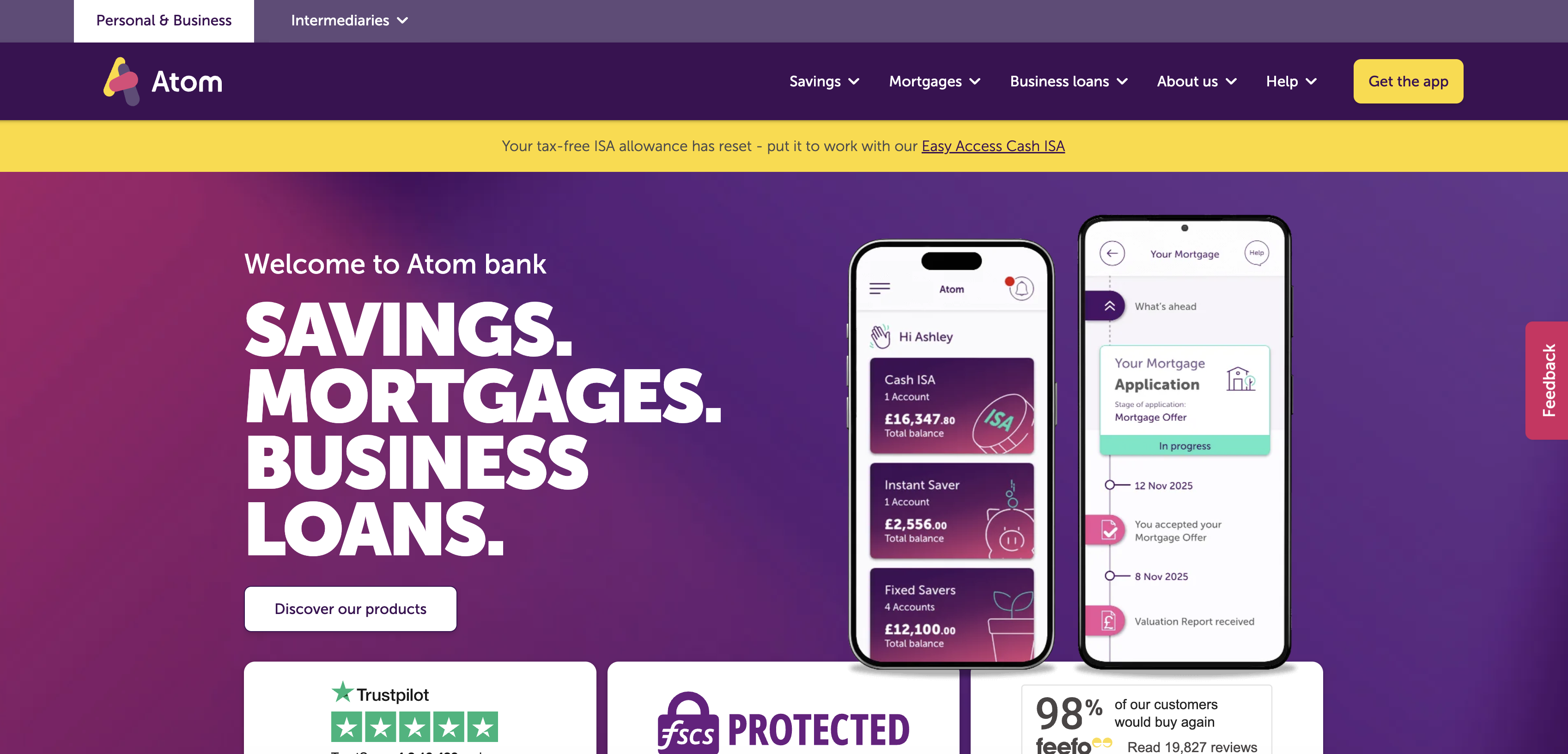
Atom Bank is a British digital bank that strips away the branch infrastructure and legacy systems weighing down traditional lenders. Launched in 2015, it operates as a fully licensed bank—not a fintech wrapper around someone else's platform—meaning it controls its own destiny in a way most digital challengers cannot. The business model is straightforward: mortgages and savings products delivered through mobile and web, with no physical locations to maintain. Atom positions itself as the thinking person's alternative to high street banks, catering to customers who've already abandoned branch visits and prefer rates that reflect efficiency rather than marble foyers. What distinguishes Atom from the crowded challenger space is its focus on residential mortgages rather than chasing the broadest possible customer base.
While most UK digital banks splinter their attention across current accounts, payments, and investing, Atom has doubled down on what it knows—lending and savings—building deeper expertise in those channels. The company serves a particular demographic: digitally native British homebuyers and savers who value transparency and competitive pricing over brand heritage. In the European fintech landscape, Atom represents a different approach than the pan-European payment processors or API-first infrastructure plays; it's a genuine bank competing on execution and simplicity rather than disruption theater. That positioning has proven durable enough to weather a competitive market and regulatory scrutiny that has claimed flashier rivals.
Founded 2015
Kviku
Lending🇪🇸 Spain
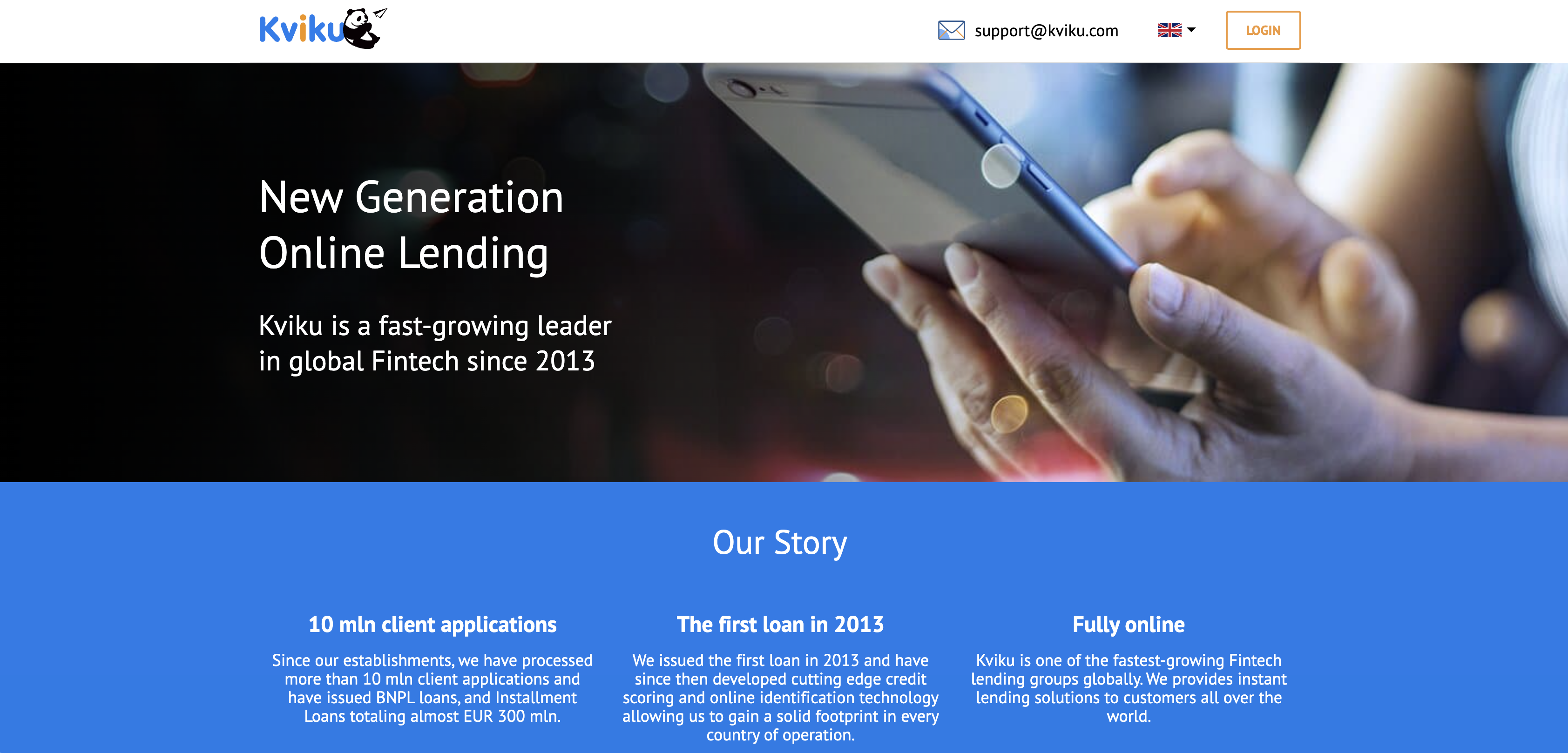
Instant credit at the point of need — a small loan approved in seconds, disbursed before the moment of purchase passes — is one of the more powerful applications of modern credit technology. Kviku was founded in 2013 and operates as a digital consumer lender offering virtual credit cards and instalment loans across multiple markets including Spain, Poland, Kazakhstan, and the Philippines. Its model is built around speed and accessibility: a fully automated underwriting process that makes credit decisions in real time using alternative data, targeting the segment of consumers who need small amounts quickly and are underserved by traditional credit products. The virtual credit card format is particularly relevant in markets where physical card infrastructure is less developed but smartphone penetration is high. Kviku operates across a wide geographic footprint for a company of its size, reflecting the scalability of a model that is fundamentally about credit technology rather than physical distribution. In the embedded finance and BNPL context, Kviku represents the direct lending end of the spectrum — not a buy now pay later product embedded in a merchant checkout, but a digital credit line that consumers carry with them to any point of purchase.
Founded 2015
Showing 12 of 27 companies. View all in the directory →