← All services

17 European companies
Market Data Providers in Europe
Market data services collect, normalise, and distribute real-time and historical price, volume, and reference data for financial instruments traded on exchanges and OTC markets. The quality and latency of market data is a direct competitive factor for trading strategies, risk management systems, and the financial products that use prices as inputs. Reliable market data is also a regulatory requirement for best execution and transaction reporting.
Typically offered by
European fintech companies offering market data
DEGIRO
Wealth🇳🇱 Netherlands
DEGIRO is a Dutch discount broker built on a single observation: the marginal cost of executing a stock trade is software and settlement, not human labour — so the fees European retail investors were paying bore little relation to what a trade actually cost. Founded in Amsterdam in 2008 by former BinckBank employees, it started as an institutional broker, opened to retail investors in 2013, and undercut the incumbents by a wide enough margin to expand across the continent within a few years.
The product is deliberately unglamorous. No gamification, no social feed, no notification congratulating you on a €5 deposit. DEGIRO offers direct access to dozens of exchanges across Europe and the US, real market data, and low per-trade pricing, and it assumes you already know what you want to buy. That utilitarian positioning has aged well as the novelty of investing apps has faded and European retail investors have matured past the onboarding experience into simply wanting to invest efficiently.
DEGIRO is no longer independent. German broker flatex AG agreed to acquire it for around €250 million in December 2019, with the legal merger into flatexDEGIRO Bank completing in May 2021. The combined group trades on the Frankfurt Stock Exchange, joined the MDAX in March 2025, and converted from an AG to a European Company (SE) at the end of 2025. It now runs three brands — DEGIRO for international European markets, flatex for Germany and Austria, and ViTrade for active traders — together serving more than 3.5 million customers across 16 countries, with over €95 billion in assets under custody and more than 75 million transactions a year. Group revenue reached €559.8 million in 2025 with net income of €160.4 million, up from €71.9 million in 2023.
The regulatory record is less tidy than the pricing story. The Dutch AFM fined the bank €2 million in 2022 over late and inaccurate reporting of unusual transactions, reduced to €797,500 on appeal in 2025. BaFin has issued a series of penalties: €1.05 million in 2023 for breaches of banking supervisory rules, accompanied by additional capital requirements and a special representative appointed to oversee remediation; €560,000 in December 2025 for advertising free investment services without clearly disclosing that a processing fee applied; and €1 million in April 2026 for failing to publish inside information promptly. Leadership has churned alongside it — CEO Frank Niehage resigned in 2024 after a public dispute with founder and major shareholder Bernd Förtsch, and former Morgan Stanley Europe CEO Oliver Behrens took over that October.
Founded 2013
ION Group
Financial Infrastructure🇬🇧 United Kingdom
Andrea Pignataro founded ION in London in 1999, after leaving a trading role at Salomon Brothers with a conviction that the software running global markets was held together with too much manual process. Over the following two and a half decades he built ION into one of the largest, most acquisitive players in capital-markets technology — absorbing dozens of specialist vendors, including Fidessa and Broadway Technology, and folding them into a single group.
The core business is still the unglamorous plumbing of institutional finance: trading platforms across equities, fixed income, foreign exchange, and cleared derivatives; risk management; post-trade processing; clearing and settlement; and market data. Investment banks, hedge funds, and corporate treasuries run parts of their daily operations on ION's systems, often without their own customers ever knowing it.
Less visible is ION's regulatory technology line. Products including ION LookOut and Fidessa Surveillance handle trade surveillance, market-abuse detection, and regulatory reporting across multiple jurisdictions, and ION's compliance tools have placed in FinTech Global's RegTech 100 list for three consecutive years. It's a smaller part of the business than the trading and post-trade platforms, but a genuine one — which is why ION appears under both Capital Markets and RegTech in this directory, rather than just one.
The company is headquartered in London, employs more than 13,000 people across over 50 offices worldwide, and remains privately held under Pignataro's control — a scale most consumer-facing fintechs never approach, built almost entirely on customers who are themselves in finance.
Founded 1999
Credit Benchmark
Financial Infrastructure🇬🇧 United Kingdom
Credit Benchmark sits at the intersection of market transparency and institutional risk management. Founded to solve a specific problem—banks and asset managers couldn't easily benchmark their credit exposures against the broader market—it's evolved into a critical infrastructure play in the institutional credit space. The platform aggregates anonymized credit opinions from major financial institutions, creating a real-time view of how the world's largest investors see credit risk. Rather than relying on traditional ratings agencies or proprietary models, Credit Benchmark lets institutions see how their views stack up against peers, identify outliers, and stress-test assumptions across thousands of corporates and sovereigns. This crowdsourced intelligence has become essential for risk committees, portfolio managers, and regulators navigating an increasingly complex credit landscape. The company operates quietly but with significant reach—used by central banks, pension funds, and major corporates to understand systemic credit risk. In a world where traditional credit signals lag reality, Credit Benchmark offers something rare: a real-time consensus view built on the opinions of sophisticated investors who have real money at stake. It's infrastructure for an industry that desperately needed transparency on how credit risk is actually perceived, not how it's officially rated.
Founded 2011
Dukascopy
Payments🇨🇭 Switzerland
Dukascopy is a Swiss online financial platform that has spent two decades building infrastructure for forex, CFD, and crypto trading. The company operates its own bank and matching engine, which sets it apart from brokers that simply resell liquidity. This infrastructure-first approach means Dukascopy can offer tight spreads and direct market access without hidden markups.
The platform caters to retail traders and small institutions who want institutional-grade tools without the price tag. Its trading terminals rival professional setups, while the mobile app keeps things simple for casual traders. Dukascopy has also moved into crypto custody and blockchain services, positioning itself as a bridge between traditional finance and digital assets.
In the crowded retail trading space, Dukascopy distinguishes itself through ownership and transparency. Many competitors are broker-dealers; Dukascopy is a bank. This matters for client money protection and operational independence. While it lacks the consumer-facing polish of newer fintech apps, it appeals to traders who value substance over hype and appreciate the regulatory weight of Swiss banking.
The company represents a different model in fintech—not a startup chasing growth at all costs, but an established financial institution quietly building depth in forex, crypto, and institutional services.
Founded 2000
Kvika
Wealth🇮🇸 Iceland
Kvika is an Icelandic investment bank and fintech firm that has quietly built something rarely seen in Europe's crowded fintech space: a full-service wealth and capital markets platform designed for serious investors, not casual traders. Founded in the early 2000s, the company operates as a licensed bank rather than a scrappy startup, which gives it something most fintechs lack—direct access to markets, custody capabilities, and institutional credibility.
The platform combines retail investment tools with professional-grade execution and advisory services. You can trade equities, bonds, funds, and derivatives across multiple exchanges, but Kvika doesn't compete on flashiness. Instead, it positions itself as the thinking investor's choice in a market saturated with gamified trading apps and commission-free broker clones.
What sets Kvika apart in the Nordic and European context is its hybrid model. It serves both individual investors seeking serious portfolio management and corporate clients needing capital markets access. The company operates with the regulatory infrastructure and market relationships that pure fintechs spend years trying to replicate, yet it maintains the technology-first approach that defines modern finance.
Kvika represents a different kind of European fintech success—one built on institutional foundations rather than disruption narratives. It's the kind of player that rarely makes headlines but quietly captures the investor who wants depth over hype.
Founded 2002
OKX
Crypto & Blockchain🇲🇹 Malta
OKX is a cryptocurrency exchange and Web3 infrastructure platform that has become one of Europe's most active crypto trading destinations. The platform combines spot and derivatives trading with a growing suite of Web3 tools, positioning itself as more than just an exchange—it's a gateway to decentralized finance and digital assets for European traders and institutions alike.
The exchange operates with institutional-grade infrastructure, offering sophisticated order types, leverage trading, and options markets that rival traditional capital markets platforms. What sets OKX apart is its commitment to European regulatory compliance and its investment in Web3 ecosystem tools, including an integrated wallet and support for blockchain exploration across multiple networks.
While most traditional exchanges struggle to navigate crypto's regulatory complexity, OKX has built operational depth in multiple European jurisdictions. It serves everyone from retail traders seeking exposure to digital assets to institutions building Web3 strategies, making it a central hub in Europe's growing crypto infrastructure layer. In the broader fintech landscape, OKX represents the convergence of trading sophistication and Web3 accessibility—a platform built for the next generation of financial infrastructure rather than merely replicating legacy models.
Founded 2017
Swissquote
Wealth🇨🇭 Switzerland
Swissquote is a Swiss online banking and investment platform that democratised retail access to capital markets long before the term fintech became fashionable. Founded in 1996, it operates as a full-service digital broker, offering everything from currency trading and stocks to cryptocurrencies and structured products—all wrapped in the kind of regulated, institutional-grade infrastructure you'd expect from Switzerland.
The platform serves both everyday investors and active traders, positioning itself as a counterweight to traditional brokers by eliminating gatekeeping and offering direct market access. Its digital-first approach means clients manage portfolios through intuitive apps and web interfaces rather than dealing with relationship managers. Swissquote has progressively expanded into crypto custody and trading, recognizing early that digital assets would become table stakes in modern wealth management.
Within Europe's competitive fintech landscape, Swissquote occupies a middle ground between pure-play neobanks and heavyweight institutional players. It lacks the brand velocity of newer challengers but carries the regulatory credibility of its Swiss heritage and banking license. The company has built longevity by staying disciplined about what it does well—trading, investing, and increasingly, custodying digital assets—rather than chasing every trend.
Today, Swissquote represents a particular archetype in European fintech: the early mover that survived consolidation, scaled sustainably, and now competes by coupling digital experience with the trust premium of being rooted in one of the world's most regulated financial jurisdictions. It's neither disruptive in the startup sense nor stagnant—it's simply a mature digital-first investment platform that works.
Founded 1996
Bux
Wealth🇳🇱 Netherlands
Bux is a mobile-first investing platform that strips away the gatekeeping around stock and ETF trading, making it accessible to anyone with a smartphone and spare change. Founded in the Netherlands, the company lets users trade fractional shares from €1 upward—a deliberate move to democratize markets that traditionally demanded thousands in upfront capital.
The core product is refreshingly simple: a clean app interface where you can buy stocks, ETFs, and crypto without the jargon or friction that traditional brokers impose. Bux's positioning sits at the intersection of retail investing and social trading, with features that encourage discovery and community engagement alongside serious portfolio building. Think of it as the antidote to the institutional gatekeeping of wealth creation.
Among European retail investment platforms, Bux stands out for its aggressive accessibility play—fractional shares, zero commissions, and a user experience designed for people who'd rather scroll than call a broker. It competes in a crowded space alongside the likes of Revolut and Trading 212, but maintains a laser focus on making investing feel less intimidating and more tangible.
In the broader fintech landscape, Bux represents a generation of platforms that have fundamentally rewritten the rules of retail access to capital markets, turning investing from a privilege into a habit.
Founded 2014
SIX Group
Financial Infrastructure🇨🇭 Switzerland
SIX is what happens when a country's banks decide to own their own plumbing. Formed in 2008 from the merger of the SWX Swiss Exchange, SIS and Telekurs, SIX Group Ltd is owned by around 120 Swiss and international financial institutions — the same banks that use it — and operates the infrastructure on which the Swiss financial centre runs: the stock exchange, securities settlement and custody, interbank payment processing, and the financial data that prices everything else. The name stands for Swiss Infrastructure and Exchange, and the ownership structure explains the strategy. A consortium-owned utility optimises for reliability and long-term position rather than for quarterly earnings, which is why SIX has been able to make acquisitions that took years to pay off.
The largest of those reshaped the company. SIX acquired Bolsas y Mercados Españoles — the operator of the Spanish stock exchange — in 2020, giving a Swiss, non-EU company a substantial regulated presence inside the European Union, and it followed in 2025 with the acquisition of the UK's Aquis Exchange. The strategic direction is explicitly pan-European: SIX has said it intends to combine SIX x-clear with BME to create a unified multi-asset central counterparty across Europe, and the stated ambition is to be a genuinely European infrastructure provider rather than a Swiss one with foreign subsidiaries. The group runs four business units — Exchanges, Securities Services, Financial Information, and Banking Services — with roughly 4,000 employees.
Operationally, 2025 was the strongest year in the company's history and the accounts still showed a loss. Net operating income rose 4.7% to CHF 1,496.5 million, EBITDA excluding transformation costs jumped 22.2% to CHF 542.3 million, and adjusted group net profit reached CHF 247.2 million, up 20.9%. The reported group result was a loss of CHF 313.7 million — entirely because of CHF 560.9 million in value adjustments on the Worldline stake. That holding is the residue of the 2018 sale of SIX's card business to Worldline, paid for in shares, and it has been written down repeatedly as Worldline's price collapsed: roughly CHF 862 million in 2023, CHF 168 million in 2024, and CHF 561 million in 2025. In November 2025 SIX reclassified the participation from an associate to a financial investment and declined to take part in Worldline's capital increase, accepting dilution from 10.5% to roughly 1.3%. The stake can no longer materially damage the accounts, which is the point. Bjørn Sibbern, the Danish former Nasdaq and OMX executive who became CEO on 1 January 2025 succeeding Jos Dijsselhof, is running a group-wide programme called Scale Up 2027 targeting an EBITDA margin above 40% by the end of 2027.
The part of SIX most relevant to fintech buyers is Financial Information, a business with over a thousand staff and around CHF 418 million in revenue whose roots run back to Ticker AG in 1930. It supplies reference data, pricing, indices, and — increasingly — regulatory and tax services, competing with Bloomberg, LSEG and SIX's own owners' internal capabilities. Within that unit sits a product worth noting because it addresses a compliance gap that the mainstream AML vendors mostly don't: the Sanctioned Securities Monitoring Service, which screens securities, issuers and investment restrictions rather than individuals and entities. Most sanctions screening in this directory — ComplyAdvantage, World-Check and their peers — answers the question of whether a person is sanctioned. Whether a specific ISIN is caught by an investment prohibition, or whether an issuer's ownership structure triggers a restriction, is a different data problem, and one that got considerably harder after 2022 as sanctions regimes moved from named individuals to sectoral and securities-level prohibitions. It is the kind of unglamorous, high-consequence dataset that a 95-year-old financial data business is well placed to maintain.
Founded 2008
Symmetrical
Capital Markets🇵🇱 Poland
Symmetrical is building the infrastructure layer for algorithmic trading—think of it as the plumbing that powers modern quantitative finance. Instead of forcing traders and quant teams into rigid, legacy systems, Symmetrical provides a cloud-native platform where they can deploy, backtest, and execute complex trading strategies at scale. The platform abstracts away the messy reality of connecting to multiple exchanges, managing order flow, and handling real-time data feeds, letting teams focus on what actually matters: the algorithm itself. What sets Symmetrical apart is its approach to multi-venue execution and risk management. While traditional venues lock you into their ecosystem, Symmetrical sits above them, orchestrating orders across multiple exchanges and liquidity sources with a single unified API. For European quant funds and prop traders, this matters—especially as market fragmentation makes it harder to find alpha across venues. The company is positioning itself as the operational backbone for a new generation of systematic traders who want speed, flexibility, and control without wrestling with decades-old infrastructure. In a landscape dominated by entrenched trading platforms, Symmetrical represents a reimagining of what modern algo trading infrastructure should actually look like.
Founded 2019
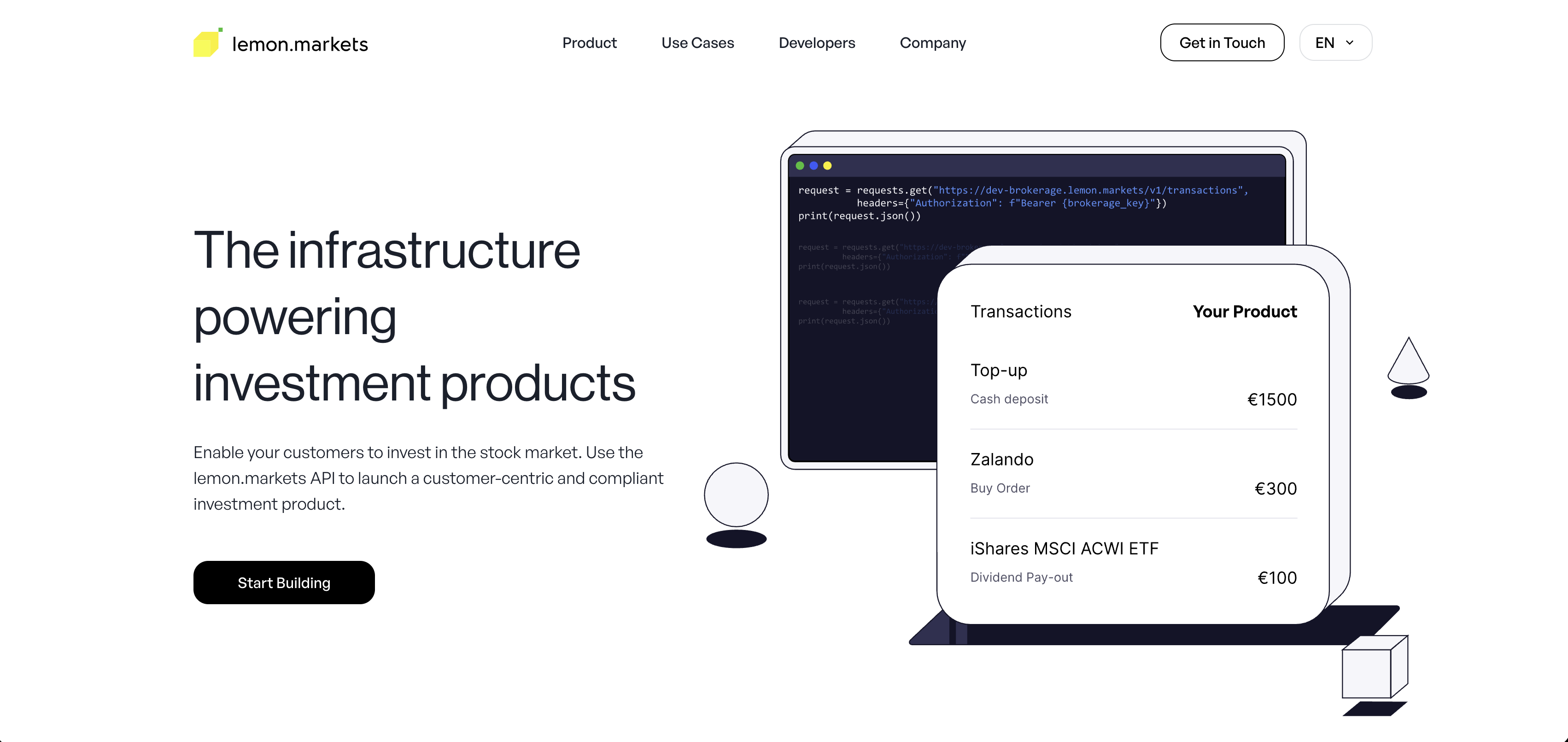
Lemon Markets
Financial Infrastructure🇩🇪 Germany
Lemon Markets is a Berlin-based fintech infrastructure platform that has stripped away the complexity of building investment services. Rather than forcing startups and established companies to navigate the labyrinth of European financial regulation and fragmented market access, Lemon Markets provides a modern, API-first foundation for trading, investing, and wealth management applications. The platform essentially democratizes access to European capital markets infrastructure that was previously locked behind expensive integrations and legacy banking relationships.
At its core, Lemon Markets connects to European stock exchanges, clearing houses, and settlement systems through a single, developer-friendly interface. This means a fintech founder can build an investment app without needing to spend months on regulatory approvals or integration nightmares. The company handles the hard infrastructure problems—market data, order routing, settlement, custody—so its clients can focus on user experience and product differentiation.
What sets Lemon Markets apart is its unabashedly technical approach. This isn't a white-label solution dressed up with templates; it's engineering-first infrastructure designed for developers. The platform has gained traction among neo-brokers, robo-advisors, and wealth management platforms across Europe, particularly in Germany, France, and beyond. It occupies a critical middle ground: more flexible and modern than legacy market infrastructure, more affordable and specialized than building everything from scratch or licensing Bloomberg terminals.
In the broader European fintech landscape, Lemon Markets represents a specific bet: that the next wave of investment apps won't be built by reinventing market infrastructure, but by companies that abstract it away entirely. As retail investing and fractional ownership become mainstream expectations, Lemon Markets sits at the plumbing layer that makes this possible.
Founded 2019
Strise
Fraud & Security🇳🇴 Norway
Strise is an AI-powered ESG risk platform built for institutional investors tired of spreadsheet-based due diligence. Instead of relying on lagging ESG ratings from traditional providers, Strise uses machine learning to surface real-time supply chain risks, labor violations, and environmental incidents that actually move portfolio companies. The platform aggregates unstructured data from thousands of sources—regulatory filings, news, satellite imagery, worker reports—and turns it into actionable risk scores that investors can trade on.
What sets Strise apart is its speed and granularity. While legacy ESG platforms deliver quarterly updates, Strise refreshes daily. It catches supply chain disruptions before they hit earnings calls and identifies geopolitical risks buried in subsidiary networks. The system learns from private investor feedback, getting smarter about what matters for specific asset classes and investment theses.
Strise positions itself as the anti-Morningstar approach to ESG—less about moral messaging, more about financial materiality. It's built for asset managers, insurers, and institutional investors who need ESG intelligence that moves faster than the news cycle. In an era where traditional ESG ratings are increasingly criticized for opacity and misalignment with actual risk, Strise offers a data-driven alternative that translates ESG into portfolio language: risk-adjusted returns.
Founded 2019
Showing 12 of 17 companies. View all in the directory →