← All services



19 European companies
Savings Automation Providers in Europe
Savings automation moves money into savings accounts, investment accounts, or savings goals automatically based on predefined rules — scheduled transfers, round-ups on transactions, or percentage-of-income rules. By removing the need for ongoing conscious decisions, savings automation dramatically improves the consistency of saving behaviour and helps users accumulate savings they would not have set aside manually.
Typically offered by
European fintech companies offering savings automation
Monzo
Wealth🇬🇧 United Kingdom
The founding team that built Monzo had all worked together before — at Starling Bank, another challenger startup that didn't survive its internal conflicts. Tom Blomfield, Gary Dolman, Jonas Huckestein, Jason Bates, and Paul Rippon left together in 2015 and started again. The product was initially a prepaid card — a coral-coloured piece of plastic that became one of the most recognisable objects in British fintech — before becoming a fully licensed current account in 2017. The early community was unusual for a bank: public engineering blogs, user forums, beta programmes, and a 2016 crowdfunding round that raised £1 million in 96 seconds, a world record. People felt ownership of the product in a way no high street bank had ever achieved, and that emotional connection became a durable competitive advantage.
A decade on, the results have caught up with the mythology. For the year to March 2026, Monzo reported revenue of £1.71 billion, up 39%, with gross profit crossing £1 billion for the first time and a third consecutive year in the black — statutory pre-tax profit of £87.3 million, up 44%, or £172.6 million adjusted for restructuring charges and a roughly £21 million FCA fine over historical financial-crime control failings. The bank added a record three million customers to reach 15.2 million — one in five UK adults — with deposits up 55% to £25.7 billion, 1.6 million paying subscribers, and business banking growing 45% to 905,000 customers and 14% of revenue. Four separate income streams — current account balances, borrowing, payments, and wealth — each now clear £300 million. Half of active customers use Monzo as their primary bank, which shows up in the metric that anchors every valuation conversation: revenue per active personal customer of £167, against Revolut's £66. The gap is the difference between being someone's bank and being their travel card.
Leadership and strategy both turned over during the year. Diana Layfield, a former Google executive, took over as CEO in February 2026 following TS Anil's departure — a transition shaped in part by board tensions over IPO venue and the company's UK concentration. Her first significant moves were decisive: Monzo closed its US operations entirely, and redirected the international ambition at Europe, where it secured a banking licence from the Central Bank of Ireland, launched in Ireland to a 100,000-person waitlist, and named Spain as the next market. The acquisition of digital mortgage broker Habito completed on 1 April 2026, giving the bank a capital-efficient route into mortgages — a product more than 550,000 customers were already tracking in the app. Costs rose with the ambition: the cost-to-income ratio ticked up to 74% as hiring and marketing accelerated.
Monzo remains private, valued at approximately $5.9 billion in its 2024 secondary sale, and Layfield has told the FT she is "not in a hurry" to list. The strategic bet of this chapter is clear and genuinely contestable: that Monzo's deep-relationship, primary-bank model — expensive to build, lucrative per customer — can be exported to European markets where Revolut arrived a decade earlier with the opposite playbook. The UK numbers say the model works. Europe will say whether it travels.
Founded 2015
Pockit
Digital Banking🇬🇧 United Kingdom
Every UK neobank claims to serve people the banks ignore. Pockit actually built its business there. Founded by Virraj Jatania in 2014 as a prepaid card, it grew into a digital account for the roughly 17.5 million UK adults underserved by mainstream banking — people with thin credit files, irregular incomes, or histories that fail high-street onboarding. The product set follows the customer: a simple account and card, cross-border transfers, early wage access, credit building, and cashback — priced as a utility rather than a lifestyle brand. It is the unfashionable end of consumer fintech, and Pockit's bet has always been that unfashionable segments are where loyalty and margins survive, precisely because nobody else is competing for them. The company also carries a scar that shaped it: in 2020, when the FCA froze Wirecard Card Solutions during the Wirecard collapse, Pockit customers were locked out of their money for days — a formative lesson in the risks of renting critical infrastructure.
The transformational move came in October 2024, when Pockit acquired Monese — the pan-European money app founded by Estonian entrepreneur Norris Koppel in 2015 — for a reported £15 million. The price is the story: Monese had raised more than $200 million from investors including HSBC, Kinnevik, and PayPal, and HSBC had already written its stake down to zero. What was a wipeout for Monese's cap table was a coup for Pockit's: the combined group serves roughly three million customers, generates around £30 million in annual revenue, and processes about £5 billion in transactions a year. Just as valuable, Monese brought e-money and consumer credit licences that cut Pockit's transaction costs and open the path to lending products for a customer base otherwise pushed toward high-cost credit — the loan-shark alternative Jatania cites as the mission's sharpest edge. Monese's B2B platform, XYB, was excluded from the deal.
Pockit is backed by Puma Growth Partners and Maven Capital, with a cap table that includes Sir Alex Ferguson, private equity veteran Jon Moulton, and the UK's Future Fund; it raised £10 million in growth funding in 2024 ahead of the acquisition. The integration has been real — headcount stands around 52 after consolidation, against the 100 Monese staff who joined at completion. Jatania's public thesis is that UK fintech is entering a consolidation phase, and Pockit is the proof-of-concept: while Monzo and Revolut fight for the mass market at nine-figure marketing budgets, Pockit is quietly rolling up the segment beneath them — buying at distressed prices the customers that cost its rivals £50 a head to acquire. Whether a low-margin customer base can support a lending business profitably is the open question; the licences to find out are now in hand.
Founded 2015
Credit Spring
Lending🇬🇧 United Kingdom
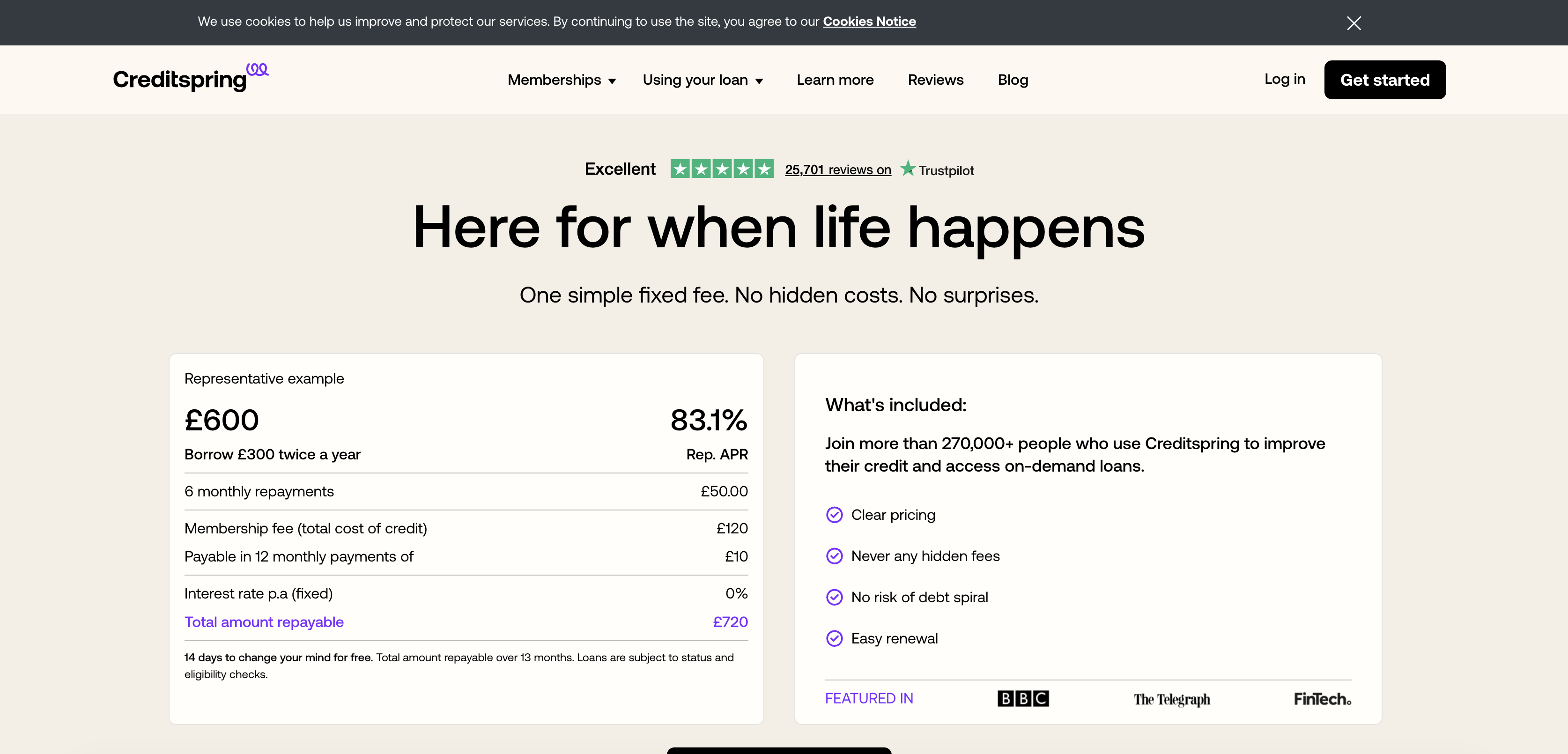
Credit Spring is a UK-based fintech that treats financial distress like a health problem—one that deserves diagnosis and treatment, not judgment. Rather than simply offering credit, the company combines short-term loans with financial coaching and debt management tools, recognizing that a quick cash injection without context is often a band-aid on a bigger problem. The platform helps borrowers understand their spending patterns and rebuild their financial foundation, not just patch a temporary shortfall. It's a provocative stance in a market crowded with BNPL and payday lenders that rarely ask why someone needs money in the first place. Credit Spring targets people in the credit-vulnerable segment—those with poor or limited credit histories who'd normally be shut out of mainstream lending. Instead of algorithmic rejection, the company uses alternative data and behavioral insights to assess creditworthiness beyond traditional scoring. For users, this means faster access to reasonable credit at transparent rates. For the market, it signals a shift toward lending that acknowledges financial fragility as a temporary state, not a permanent condition. The company represents a broader move within fintech to attach financial wellness services to credit products, treating lending as an entry point to deeper financial health rather than a transaction.
Founded 2016
Scalable Capital
Wealth🇩🇪 Germany
Scalable Capital was founded in Munich in 2014 by an unusually complementary quartet: Erik Podzuweit, a former Goldman Sachs banker; Florian Prucker, his co-CEO to this day; Adam French, who built the UK business; and Stefan Mittnik, an econometrics professor who gave the company its quantitative risk-management backbone. The product they launched in 2016 was a robo-advisor — algorithmically managed ETF portfolios for German savers who had money in zero-interest accounts and no relationship with the stock market. The early growth hack was distribution rather than marketing: a 2017 partnership put Scalable's digital wealth management inside ING Germany's retail bank, and BlackRock joined the cap table the same year. By 2018 it was managing €1 billion and ranked among the fastest-growing robo-advisors anywhere.
The decision that transformed the company came in 2020: the launch of Scalable Broker, a flat-fee trading platform built around a subscription model — the PRIME tiers — rather than per-trade commissions. It arrived at exactly the moment a generation of Germans discovered investing, and it made recurring ETF savings plans, the culturally German path into the market, effectively free at scale. Scalable became one of continental Europe's two dominant neobrokers, locked in a now decade-defining duel with Berlin's Trade Republic, with the low-cost incumbent DEGIRO fighting the same war from the Netherlands.
What distinguishes Scalable strategically is how far it has pushed vertical integration. When the EU banned payment for order flow — the revenue model most neobrokers were built on — Scalable's answer was to co-found its own trading venue, the European Investor Exchange, with Börse Hannover in 2023, keeping headline trading costs low by bringing execution in-house. It launched its own World ETF with DWS and MSCI in 2024, and opened private equity access to retail investors through a BlackRock partnership in 2025. Independent reviewers note the obvious tension in this design: when a broker routes client orders to its own exchange, execution quality and spreads deserve as much scrutiny as the visible fees — a fair caveat about a structure that is otherwise a genuine competitive moat.
The capstone came in September 2025, when the European Central Bank granted Scalable Capital a full banking licence, making it a CRR credit institution supervised by BaFin and the Bundesbank. The licence collapsed the remaining dependency on partner banks: Scalable now handles custody, clearing, settlement, deposits, and lending itself. Interest-bearing deposits launched within weeks, spread across Scalable's own bank and partner institutions with the distribution visible in-app, and a flexible credit product followed — loans from €1,000 to €250,000 with no fixed term. Podzuweit's framing of the ambition is lifelong: everything a customer and their family need for investing, saving, and financing, from the first savings-plan euro to retirement. It's the same full-stack endgame Trade Republic reached via its own licence — the two German rivals have independently concluded that the neobroker business ends in becoming a bank.
The scale now backs the ambition. Scalable Capital manages more than €30 billion for over one million customers across Germany, Austria, France, Italy, Spain, and the Netherlands, with around 845 employees across Munich, Berlin, London, Vienna, and Milan. A $175 million round led by Sofina and Noteus Partners in June 2025 — joined by Balderton, Tencent, and HV Capital — took total funding past half a billion dollars, three months before the banking licence landed. A decade in, the company that started by automating ETF portfolios for cautious German savers has become one of Europe's few vertically integrated investment banks for retail: its own exchange, its own ETF, its own banking licence, and a product that now touches every stage of a customer's financial life.
Founded 2014
Avanza
Wealth🇸🇪 Sweden
Avanza is Sweden's largest independent online brokerage, a no-frills investment platform that democratized stock trading for Swedish retail investors two decades ago. What started as a scrappy alternative to traditional banks has become the go-to app for millennials and Gen Z who want to trade, invest, and save without paying legacy banking fees. The platform strips away unnecessary complexity—no advisors, no jargon, just direct market access at transparent prices. Avanza operates in that interesting middle ground between a neobank and a pure trading platform. It offers savings accounts, pension accounts, and investment accounts with a sharp focus on user experience and low costs. The company has built a cultural following in Sweden, becoming almost synonymous with retail investing for a generation that views traditional brokers as relics. Beyond just equities and funds, Avanza has expanded into savings products, retirement planning, and financial education—positioning itself as a genuine financial companion rather than just a transaction layer. Its dominance in the Nordic market reflects a broader European shift toward direct-to-consumer investment platforms that compete on transparency, speed, and mobile-first design. Avanza exemplifies how fintech can win by doing one thing exceptionally well and then expanding thoughtfully into adjacent categories. The company's influence extends beyond Sweden into a broader shift in how younger Europeans think about investing: without gatekeepers, without unnecessary fees, and entirely on their own terms.
Founded 1999
OneFor
Lending🇬🇧 United Kingdom
OneFor is a European fintech platform that reimagines how SMEs access and manage working capital. Rather than treating finance as a transactional afterthought, OneFor embeds cash flow tools, invoice financing, and dynamic credit solutions directly into the workflows where small business owners actually work. The platform pulls together accounts data, payment history, and real-time transaction flows to offer instant access to capital without the friction of traditional bank applications.
What sets OneFor apart is its positioning as a cash flow operating system rather than just another lending product. It serves companies that traditional banks have largely abandoned—the messy middle of European small business—by automating the visibility and accessibility of working capital. While legacy banks still demand spreadsheets and weeks of underwriting, OneFor delivers decisions in hours using behavioral data and API connections to accounting software.
The company operates across Western Europe with particular traction in the UK and Nordics, building a loyal following among founders who've grown tired of juggling multiple finance tools. Its integration-first approach means OneFor sits comfortably alongside existing business software stacks, making it feel less like switching banks and more like upgrading your CFO's toolkit. In a crowded SME finance space, OneFor's bet is that speed, transparency, and embedded simplicity will ultimately win over traditional lending relationships.
Founded 2020
FinFrog
Digital Banking🇫🇷 France
FinFrog is a French neobank designed for the Instagram generation—a mobile-first challenger that strips away the pretense of traditional banking and treats financial management like a social experience. Rather than positioning itself as a replacement for your main bank, FinFrog positions as the fun account you actually use, complete with spending analytics that actually make sense and a card that feels like an extension of your lifestyle rather than a financial obligation.
The platform focuses on real-time spending visibility, automated savings mechanisms, and a philosophy that younger Europeans shouldn't have to tolerate clunky interfaces or hidden fees just to manage their money. It's built on the premise that financial literacy and engagement happen through friction-free, mobile-native experiences, not through apps bolted onto legacy systems.
Within the European challenger banking landscape, FinFrog carves out space by leaning heavily into design and user experience clarity rather than attempting to be everything at once. While competitors chase feature bloat, FinFrog has maintained focus on core banking and budgeting fundamentals executed at a level that feels genuinely differentiated.
As part of the broader shift toward mobile-first financial services in continental Europe, FinFrog represents the next wave of neobanks that treat banking as a utility that should be boring, fast, and actually yours—no corporate messaging, no pretense, just money that works.
Founded 2018
Hype
Digital Banking🇮🇹 Italy
Hype is Italy's answer to the mobile banking revolution, a neobank that has spent nearly a decade proving that digital-first doesn't mean stripped-down. Rather than chase global scale with generic features, Hype has built a hyperlocal following by understanding what young Italians actually want from their money: instant transfers, cashback rewards, zero monthly fees, and a sleek app that doesn't feel like it was designed by a committee of compliance officers.
The platform operates as a digital-only current account backed by actual IBAN credentials, so it's not playing at banking—it's the real thing, licensed and regulated. Users get a contactless Mastercard, push-notification alerts for every transaction, and the kind of interface that makes traditional banking feel positively medieval by comparison. Hype's cashback ecosystem is its signature move, offering percentage returns on spending across partner merchants, which transforms the app from a mere account holder into a lifestyle spending companion.
In a market where European neobanks have largely converged around identical feature sets, Hype has chosen to go deep rather than broad, cementing itself as the default neobank for Italian millennials and Gen Z. It's proof that you don't need hundreds of millions in funding or ambitions to be present in every time zone to build something genuinely meaningful. The company represents a particular kind of fintech success: profitable, focused, and beloved by its core audience rather than chased by venture capitalists.
Hype demonstrates that the future of banking in Europe isn't about creating one global super-app, but rather a network of fiercely intelligent regional players, each optimized for the specific financial behaviors and preferences of their home market.
Founded 2014
Lydia
Payments🇫🇷 France
Splitting a restaurant bill used to involve a painful combination of mental arithmetic, someone forgetting their wallet, and a group negotiation about whether to ask for separate checks. Lydia was founded in Paris in 2013 to make that specific moment effortless — and in doing so, became the dominant peer-to-peer payment app in France. Its simple interface for sending and requesting money between contacts captured a generation of French users who had grown up with PayPal but wanted something faster and more mobile-native. Lydia expanded beyond P2P transfers into a broader financial platform, adding savings accounts, investment products, and consumer credit — the classic neobank expansion playbook, executed in a market where Revolut and N26 were competing aggressively for the same digitally native users. The company rebranded its premium offering as Sumeria in 2023, signalling an evolution from a payment utility into a full financial product. In the French fintech landscape, which has historically been dominated by the large banking groups, Lydia built something rare: a consumer brand with genuine affection from its users, built on the back of a product so simple that it spread without marketing.
Founded 2013
Chip
Digital Banking🇬🇧 United Kingdom
Chip is a savings app that treats your money like it's on autopilot. Rather than asking you to manually set aside cash each month, Chip uses machine learning to analyze your spending patterns and automatically moves small amounts into a separate savings pot whenever it detects you can afford it. Think of it as a financial safety net that works in the background—no willpower required, just consistent, painless saving. The app integrates with your main bank account and learns your habits over time, adjusting how much it saves as your circumstances change. It's designed for people who want to build a financial cushion but struggle with the discipline of traditional budgeting. Chip democratizes financial discipline by removing the human friction from saving. Most savings apps ask you to commit upfront or rely on manual contributions; Chip does the thinking for you. The platform has become a trusted companion for UK consumers looking to pad their emergency fund without the guilt of underspending or oversaving. In the broader fintech landscape, Chip represents a shift toward behavioral finance—using technology and psychology to nudge people toward better financial habits rather than relying on willpower alone.
Founded 2016
Plum
Personal Finance🇬🇧 United Kingdom
Plum is a savings app that turns the friction out of putting money aside. Built on the principle that most people want to save but struggle with the discipline, Plum uses behavioral economics and gentle nudges to make automatic saving feel effortless rather than punishing.
The app connects to your bank account and uses AI to analyze your spending patterns, identifying money you're unlikely to miss. It then rounds up purchases, sweeps spare change, or sets aside a calculated percentage of income—all without requiring you to think about it. The interface is deliberately simple: no endless menus, no gamification, just periodic notifications showing you've hit a new savings milestone.
In a market crowded with aspirational fintech, Plum takes a different angle. It doesn't try to make you feel guilty about spending or celebrate every pound saved like you've won the lottery. Instead, it acknowledges that real people live complicated financial lives and builds around that reality rather than against it.
The company operates across the UK and EU, serving hundreds of thousands of users who've collectively saved hundreds of millions. Plum is carving out a distinct position in personal finance by solving for the one thing most savings apps miss: making it genuinely stick.
Founded 2016
Cleo
Personal Finance🇬🇧 United Kingdom
Cleo is a financial wellness app that meets you where you actually live: in your phone. Rather than another banking dashboard or budgeting spreadsheet, Cleo uses conversational AI to help you understand your money in real time, spot spending patterns you'd otherwise miss, and make better decisions without the friction of traditional finance apps.
The platform works as an intelligent money assistant embedded directly in your messaging apps—think of it as having a no-judgment financial coach in your pocket. It analyzes your transactions as they happen, flags unusual spending, alerts you to bills you might forget, and helps you save by automating small deposits when you have breathing room in your account. The experience feels less like finance and more like having a smart friend who actually knows your money.
Cleo operates in a crowded personal finance space, but its conversational, AI-first approach sets it apart from traditional budgeting apps that rely on charts and dashboards. Where most money apps treat finance as a problem to be solved with data visualization, Cleo treats it as a conversation. The company has built significant traction across Europe and North America by making financial management feel natural and accessible rather than intimidating.
In a fintech landscape increasingly built on APIs and automation, Cleo represents the human side of the equation—proving that sometimes the best financial tool is the one that feels less like a tool and more like advice from someone who gets it.
Founded 2015
Showing 12 of 19 companies. View all in the directory →