DatabaseCategoriesServicesCountriesArticlesNewsletterRequest listing
← All countries
🇧🇪

Fintech in Belgium

10 companies·View all in directory →
About the Belgium fintech ecosystem

Belgium hosts some of Europe's most important financial infrastructure, including the Society for Worldwide Interbank Financial Telecommunication (SWIFT) and Euroclear, the world's largest securities settlement system — both headquartered outside Brussels. This institutional concentration in critical financial infrastructure has shaped Belgium's fintech ecosystem toward B2B financial infrastructure, payment systems, and institutional-grade financial technology.

Bancontact is Belgium's dominant domestic card payment scheme, used for the majority of in-person and online Belgian card transactions — similar to iDEAL in the Netherlands and BLIK in Poland. Payconiq, which merged its operations with Bancontact, provides the mobile payment infrastructure built on this foundation.

The National Bank of Belgium and the Financial Services and Markets Authority (FSMA) jointly regulate Belgian financial services within the EU framework. Brussels' position as the de facto capital of the EU makes it uniquely proximate to European regulatory developments, giving Belgian fintechs early visibility into forthcoming regulation under PSD3, the Instant Payments Regulation, and DORA.

Fintech companies based in Belgium

Cake
Cake
Open Banking
Cake helps consumers understand spending and earn rewards through bank-connected insights.
Founded 2018
Vodeno
Vodeno
Embedded Finance
Vodeno is a European fintech building the infrastructure layer for embedded finance—letting any company slip banking and lending directly into their product without the complexity of traditional integrations. The platform abstracts away the operational headaches of regulatory compliance, bank connectivity, and fund management that typically come with embedding financial services, making it possible for non-financial businesses to offer credit, accounts, and payments to their users almost as easily as adding a API call. What sets Vodeno apart is its focus on the operational backbone rather than the customer-facing experience. While most embedded finance platforms emphasize sleek user flows, Vodeno solves the unglamorous but critical problem: how do you actually manage the banking, settlement, and risk infrastructure when you're issuing credit to thousands of users across multiple jurisdictions? They handle the plumbing that traditional banks spent decades building. The company targets both B2B2C platforms and B2B software providers looking to monetize their customer relationships through financial products. It competes in a growing category alongside players like Marqeta and Unit, but Vodeno's European roots give it a natural advantage in navigating the continent's fragmented regulatory landscape and banking infrastructure. As embedded finance reshapes how non-financial companies interact with their customers, platforms like Vodeno are becoming essential infrastructure—sitting invisibly in the background, making finance work at speed.
Founded 2021
Accountable
Accountable
SME Finance
Accountable helps freelancers manage taxes, expenses, and accounting from an app.
Founded 2017
Digiteal
Digiteal
Payments
Digiteal provides electronic invoicing and payment solutions for billers and consumers.
Founded 2015
Twikey
Twikey
Payments
Twikey sits at the intersection of payment orchestration and direct debit management, solving a problem most European fintechs have overlooked: how to automate recurring payments at scale. The platform enables businesses to collect payments via SEPA direct debit, card, and bank transfer—all orchestrated through a single API that feels less like legacy plumbing and more like modern infrastructure. Rather than forcing companies to juggle multiple payment rails and compliance frameworks, Twikey abstracts the complexity into intuitive workflows that handle mandate management, collections, and reconciliation with minimal friction. What sets Twikey apart is its obsession with the boring-but-critical work: ensuring compliance across jurisdictions, reducing failed payments through intelligent retry logic, and making recurring billing feel frictionless for both merchants and their customers. The company operates primarily in Western Europe but has built a platform designed to scale across the continent. In a landscape crowded with payment processors chasing flashy one-off transactions, Twikey has carved out territory in the unglamorous but lucrative recurring payment economy, where consistency and reliability matter far more than novelty. It's fintech infrastructure that doesn't try to be sexy—it just tries to work.
Founded 2013
Payconiq
Payconiq
Payments
Payconiq operates at the intersection of mobile payments and merchant acquiring, building infrastructure that lets small shops and big retailers alike accept payments however their customers want to pay. Founded in Belgium and now operating across multiple European markets, the company has positioned itself as a bridge between the traditional card rails and the newer world of instant payments and digital wallets. Rather than forcing merchants into choosing between payment methods, Payconiq orchestrates them all—cards, mobile wallets, bank transfers—through a single integration. This unified approach appeals to retailers who are tired of managing separate terminals and reconciling multiple payment channels. What sets Payconiq apart in a crowded acquiring space is its focus on simplicity without sacrificing functionality. The platform handles the technical complexity—tokenization, fraud detection, settlement—so merchants can focus on running their business. It's built for the realities of modern retail: smaller merchants need affordable entry points, larger chains need API flexibility, and everyone wants visibility into their transactions. Payconiq's strategy reflects a deeper shift in European payments: the move away from hardware-centric acquiring toward software-first solutions that treat payment acceptance as a service rather than a product. In an industry where incumbent acquirers still dominate through sheer distribution, Payconiq represents the challenger mentality—stripping away legacy complexity and rebuilding payment acceptance from first principles.
Founded 2013
Argenta
Argenta
Wealth
Argenta is a Belgian bank built for everyday people who want straightforward, no-nonsense banking without the corporate theatre. Founded in the early 1990s, it operates as a lean, customer-owned cooperative—a structure that shapes everything from its fee philosophy to its digital experience. Rather than chasing fintech disruption points, Argenta focuses on doing traditional banking services well: savings accounts, mortgages, personal loans, and investments, all accessible through a solid mobile app and online platform. The bank has carved out a distinctive position by staying independent and member-focused in a market dominated by larger European players. It doesn't compete on cryptocurrency or embedded finance; instead, it emphasizes fair pricing, transparency, and a digital experience that actually works for the average Belgian. Its customer base skews practical—people who want a bank that handles their money competently without asking them to adopt a persona as a "retail investor" or "digital native." Argenta occupies a middle ground between traditional retail banking and the pure-play neobank movement. It's relevant to the broader fintech conversation not as an innovator, but as a proof point that in mature European markets, there's durable demand for a bank that simply executes the fundamentals well and keeps customer interests aligned with its own. For Belgium specifically, it remains a credible alternative to the multinational banking incumbents.
Founded 1989
Qover
Qover
Embedded Finance
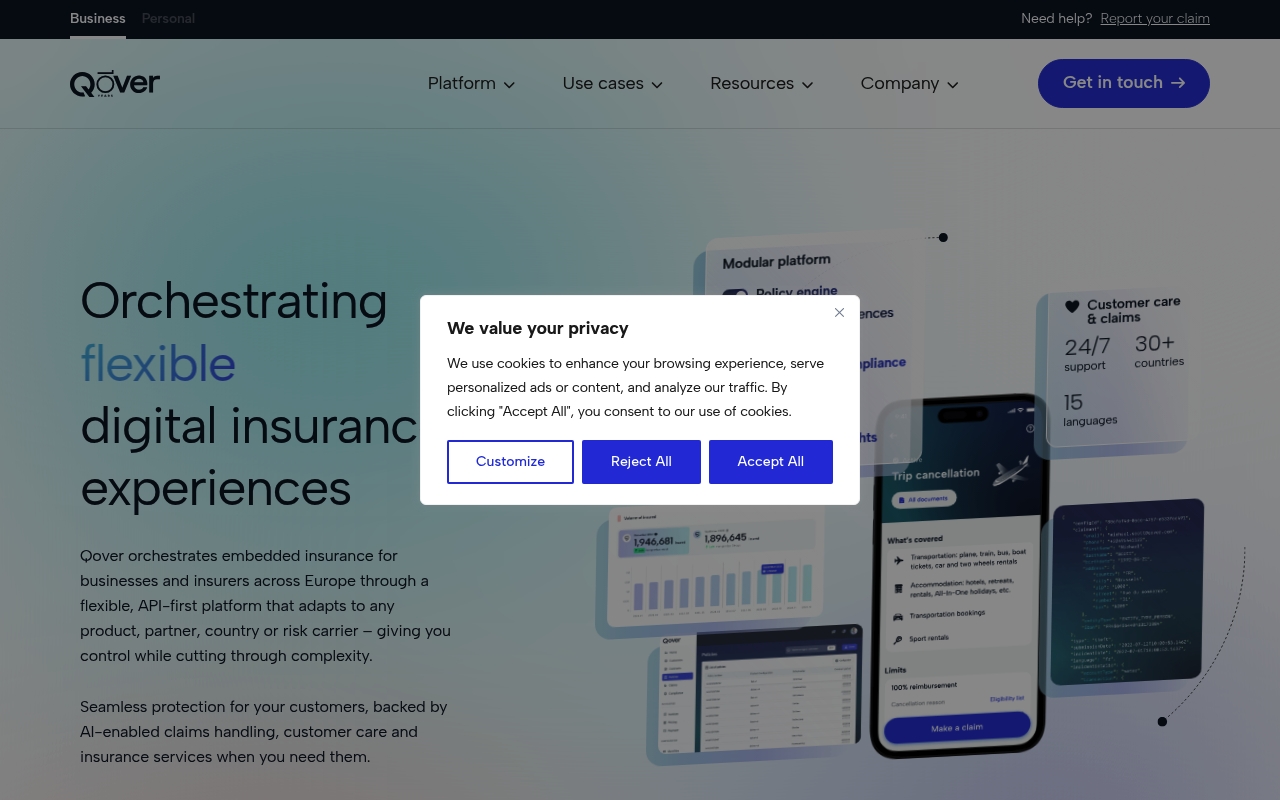
Qover sits in the gap between insurance carriers, who have capital and licences but poor distribution, and consumer brands, who have millions of engaged users but no interest in becoming insurers. Founded in Brussels in 2016 by Quentin Colmant — previously a senior figure at Allianz Benelux — and Jean-Charles Velge, it built an API-first orchestration platform that lets a company embed insurance as a native feature of its own product, with Qover handling the regulatory, carrier and lifecycle complexity underneath. The partner list is the argument. Qover powers embedded insurance programmes for Revolut, Monzo, bunq, Mastercard, BMW, Deliveroo, Canyon, Cowboy and Trust Travel (a TUI brand), across more than 32 countries. Those are wildly different use cases — travel cover inside a banking app, device protection alongside a purchase, injury cover for gig workers — running on the same orchestration layer, which is the point: the platform's value is that cross-border insurance distribution becomes a configuration problem rather than a licensing project in every market. Ten years in, the numbers are respectable rather than explosive: around 15 million people protected, over $173 million in gross written premiums, revenue tripled over four years, and total funding past $100 million. The most recent raise, in March 2026, is itself informative — a $12 million growth capital facility from CIBC Innovation Banking rather than an equity round, which is what a company does when it wants runway without dilution and believes its economics support debt. The stated targets are ambitious to the point of requiring scrutiny: 55 million people protected by the end of 2026, up from 15 million, and 100 million by 2030. That trajectory depends almost entirely on a small number of very large partners rolling out programmes on schedule — which is both the strength and the concentration risk of the orchestration model.
Founded 2016
Neterium
Neterium
Embedded Finance
Neterium sits at the intersection of enterprise infrastructure and embedded finance, building payment rails for companies that want to monetize financial services without becoming fintech themselves. The platform handles the technical grunt work—card issuing, wallet management, transaction settling—letting software businesses focus on their core product while capturing new revenue streams through white-label finance. What sets Neterium apart is its developer-first approach. Rather than forcing companies into rigid integrations, it offers modular APIs that slot into existing ecosystems. You're not ripping out infrastructure; you're plugging in a financial operating system that feels native to your product. Most fintech infrastructure companies treat their partners as clients needing onboarding. Neterium treats them as extensions of its own platform—the distinction matters. It competes less with traditional payment processors and more with companies trying to build financial capabilities in-house, which is why its positioning resonates with the new wave of vertical SaaS and embedded finance platforms. In the broader landscape, Neterium represents a quiet but significant trend: the financialization of non-financial software. As consumer and business applications become increasingly financial in nature, companies like this provide the scaffolding that makes that transition possible without requiring teams to become banking experts.
Founded 2021
KBC
KBC
Wealth
KBC is a large integrated financial services group headquartered in Belgium, offering retail banking, insurance, and investment services across Belgium, Czech Republic, Hungary, and Slovakia. Founded in 1998 through a merger, it operates as a universal bank serving millions of customers through its retail banking division, which provides checking accounts, savings products, mortgages, and personal loans alongside comprehensive insurance offerings and wealth management services. The group maintains a significant digital presence with mobile and online banking platforms, competing in a crowded European banking landscape where traditional universal banks are increasingly challenged by digital-native challengers and specialized fintech players. KBC represents the established institutional player—well-capitalized, heavily regulated, and built on decades of branch infrastructure—while navigating the shift toward digital-first customer expectations and open banking standards that are reshaping traditional banking economics across the continent.
Founded 1998