← All services
7 European companies
Clearing Systems Providers in Europe
Clearing systems are the financial market infrastructure that reconciles and confirms trades between buyers and sellers before final settlement occurs. Central counterparty clearing houses (CCPs) interpose themselves between counterparties, guaranteeing settlement and managing counterparty risk. For fintech companies building on financial market infrastructure, connectivity to clearing systems is essential for supporting regulated financial instruments.
Typically offered by
European fintech companies offering clearing systems
Lendable
Capital Markets🇬🇧 United Kingdom
Lendable is the most valuable European fintech most consumers have never heard of, which is partly by design. Martin Kissinger — German-born, LSE and Oxford, an entrepreneur-in-residence at Rocket Internet before founding his own company — started it in London in 2014 with Victoria van Lennep, Paul Pamment, and Jakob Schwarz, in the dying days of the peer-to-peer lending era. The insight that outlived P2P was structural: don't hold loans on your own balance sheet and don't take retail money — aggregate institutional capital from pension funds and hedge funds, and compete purely on underwriting. Lendable's machine-learning models automate credit decisions end to end, approving personal loans in seconds, and the company takes fees for origination and servicing while the institutions take the credit risk. Asset-light, capital-efficient, and — unusually for the category — profitable early and quietly, a combination that had Sifted profiling it as one of Europe's most secretive fintechs back in 2020.
The quiet ended with the numbers. Revenue jumped 90% to £446 million in 2025 with profits more than doubling, and Experian data showed Lendable issued more new consumer credit loans by volume than any other UK lender that year — any bank included — while ranking second in new credit cards issued. A twelve-year-old company with 643 employees out-originating institutions with balance sheets a hundred times its size is the clearest available evidence that consumer credit underwriting is now a data and automation problem, not a branch-network problem. The product range has widened from personal loans into credit cards and car finance, and in July 2026 the company priced its debut public securitisation — a £500 million deal backed by UK personal loans under the Hoxton Consumer Loan Funding programme — opening a cheaper, deeper funding channel alongside its institutional partnerships.
The capital story has been correspondingly disciplined: roughly $290 million in equity across its history, a £210 million round led by Ontario Teachers' Pension Plan in March 2022 valuing the company at £3.5 billion, and Goldman Sachs among the backers. The valuation hasn't been retested publicly since — which cuts both ways in a repriced fintech market — and the IPO question follows Lendable around as persistently as it follows Monzo, with nothing filed. Expansion is the current chapter: the US operation established in 2021 is where profits are being reinvested, with Mexico planned next. Kissinger's thesis for why a lender travels better than a neobank is worth noting — personal loans and credit cards are structurally similar across markets, while current-account propositions are deeply local.
The honest caveat is the one that applies to every consumer lender that has only grown: Lendable's model has been profitable through a decade that included a pandemic and a rate shock, but unsecured consumer credit is cyclical, and an originator whose volumes now lead the UK market carries UK household credit exposure at scale — mediated to institutional investors, but reputationally and operationally its own. The machine has out-underwritten the banks in benign and bumpy conditions alike; a genuine credit downturn remains the test that separates good models from lucky ones.
Founded 2013
ION Group
Financial Infrastructure🇬🇧 United Kingdom
Andrea Pignataro founded ION in London in 1999, after leaving a trading role at Salomon Brothers with a conviction that the software running global markets was held together with too much manual process. Over the following two and a half decades he built ION into one of the largest, most acquisitive players in capital-markets technology — absorbing dozens of specialist vendors, including Fidessa and Broadway Technology, and folding them into a single group.
The core business is still the unglamorous plumbing of institutional finance: trading platforms across equities, fixed income, foreign exchange, and cleared derivatives; risk management; post-trade processing; clearing and settlement; and market data. Investment banks, hedge funds, and corporate treasuries run parts of their daily operations on ION's systems, often without their own customers ever knowing it.
Less visible is ION's regulatory technology line. Products including ION LookOut and Fidessa Surveillance handle trade surveillance, market-abuse detection, and regulatory reporting across multiple jurisdictions, and ION's compliance tools have placed in FinTech Global's RegTech 100 list for three consecutive years. It's a smaller part of the business than the trading and post-trade platforms, but a genuine one — which is why ION appears under both Capital Markets and RegTech in this directory, rather than just one.
The company is headquartered in London, employs more than 13,000 people across over 50 offices worldwide, and remains privately held under Pignataro's control — a scale most consumer-facing fintechs never approach, built almost entirely on customers who are themselves in finance.
Founded 1999
Frictionless Markets
Financial Infrastructure🇱🇺 Luxembourg
Frictionless Markets is building the infrastructure layer for cross-border capital flows in Europe. Rather than forcing companies to navigate fragmented clearing and settlement systems across jurisdictions, they've created a unified platform that collapses the friction out of moving money across borders—think of it as the plumbing that lets financial institutions actually operate seamlessly across the continent.
The company tackles a surprisingly stubborn problem: despite decades of fintech progress, moving capital between countries still involves Byzantine manual processes, multiple intermediaries, and settlement delays that would make a 1990s bank nervous. Frictionless automates what should be simple, letting institutions execute, clear, and settle cross-border transactions in a fraction of the time it currently takes.
What sets them apart is their approach to the European market specifically. While global platforms treat Europe as one market, Frictionless has built infrastructure that actually understands and respects the regional regulatory mosaic—different clearing codes, settlement windows, compliance requirements. They're not trying to bulldoze standardization; they're engineering around fragmentation.
The company sits at the critical intersection where traditional finance infrastructure meets modern fintech. As regulatory frameworks like T2S consolidation and PSD3 continue reshaping European payments, Frictionless is positioned as the connective tissue that makes the transition actually work for mid-market institutions.
Founded 2022
Tokeny
Financial Infrastructure🇱🇺 Luxembourg
Tokeny sits at the intersection of traditional finance and blockchain, building the infrastructure for institutions to tokenize real-world assets. The company transforms illiquid holdings—real estate, private equity, bonds, commodities—into tradeable digital securities, giving wealth managers and asset owners a way to unlock capital without the friction of traditional markets.
What sets Tokeny apart is its focus on institutional credibility. Rather than chasing retail crypto excitement, the company has built compliance-first tooling that speaks the language of regulators, custodians, and fund administrators. Their platform handles the entire lifecycle: issuance, custody, trading, and settlement, all wrapped in the governance frameworks that institutional clients actually need.
The European fintech scene is crowded with blockchain evangelists; Tokeny reads differently. It's less "decentralize everything" and more "make institutional finance move at digital speed." In a market where real asset tokenization is still nascent, Tokeny occupies the pragmatic middle ground—Web3 infrastructure without the ideology.
The company is positioning itself as essential plumbing for an inevitable shift: the digitization of capital markets. As regulatory frameworks clarify across Europe, tokenization moves from proof-of-concept to production, and Tokeny's early positioning in the institutional layer could prove valuable.
Founded 2017
SIX Group
Financial Infrastructure🇨🇭 Switzerland
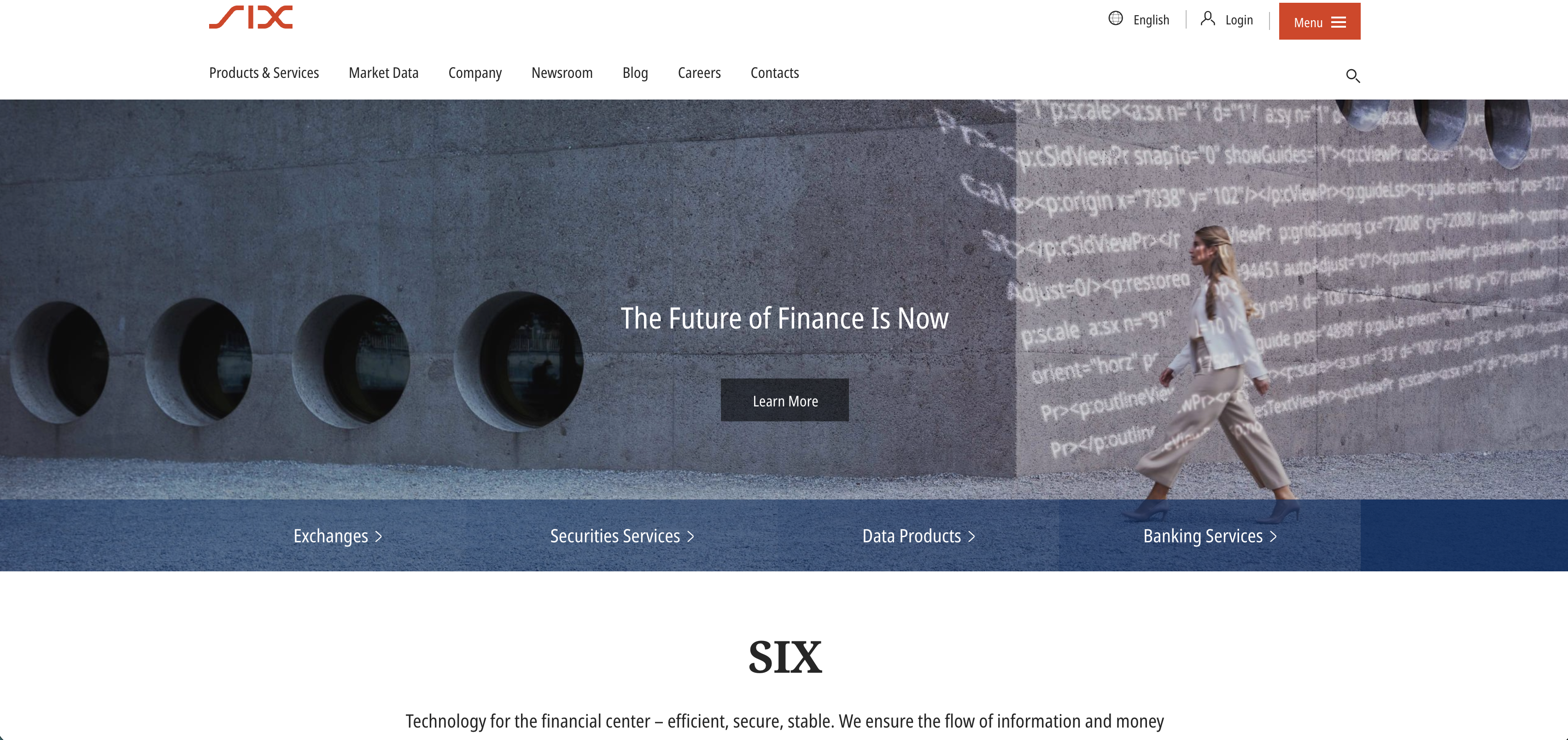
SIX is what happens when a country's banks decide to own their own plumbing. Formed in 2008 from the merger of the SWX Swiss Exchange, SIS and Telekurs, SIX Group Ltd is owned by around 120 Swiss and international financial institutions — the same banks that use it — and operates the infrastructure on which the Swiss financial centre runs: the stock exchange, securities settlement and custody, interbank payment processing, and the financial data that prices everything else. The name stands for Swiss Infrastructure and Exchange, and the ownership structure explains the strategy. A consortium-owned utility optimises for reliability and long-term position rather than for quarterly earnings, which is why SIX has been able to make acquisitions that took years to pay off.
The largest of those reshaped the company. SIX acquired Bolsas y Mercados Españoles — the operator of the Spanish stock exchange — in 2020, giving a Swiss, non-EU company a substantial regulated presence inside the European Union, and it followed in 2025 with the acquisition of the UK's Aquis Exchange. The strategic direction is explicitly pan-European: SIX has said it intends to combine SIX x-clear with BME to create a unified multi-asset central counterparty across Europe, and the stated ambition is to be a genuinely European infrastructure provider rather than a Swiss one with foreign subsidiaries. The group runs four business units — Exchanges, Securities Services, Financial Information, and Banking Services — with roughly 4,000 employees.
Operationally, 2025 was the strongest year in the company's history and the accounts still showed a loss. Net operating income rose 4.7% to CHF 1,496.5 million, EBITDA excluding transformation costs jumped 22.2% to CHF 542.3 million, and adjusted group net profit reached CHF 247.2 million, up 20.9%. The reported group result was a loss of CHF 313.7 million — entirely because of CHF 560.9 million in value adjustments on the Worldline stake. That holding is the residue of the 2018 sale of SIX's card business to Worldline, paid for in shares, and it has been written down repeatedly as Worldline's price collapsed: roughly CHF 862 million in 2023, CHF 168 million in 2024, and CHF 561 million in 2025. In November 2025 SIX reclassified the participation from an associate to a financial investment and declined to take part in Worldline's capital increase, accepting dilution from 10.5% to roughly 1.3%. The stake can no longer materially damage the accounts, which is the point. Bjørn Sibbern, the Danish former Nasdaq and OMX executive who became CEO on 1 January 2025 succeeding Jos Dijsselhof, is running a group-wide programme called Scale Up 2027 targeting an EBITDA margin above 40% by the end of 2027.
The part of SIX most relevant to fintech buyers is Financial Information, a business with over a thousand staff and around CHF 418 million in revenue whose roots run back to Ticker AG in 1930. It supplies reference data, pricing, indices, and — increasingly — regulatory and tax services, competing with Bloomberg, LSEG and SIX's own owners' internal capabilities. Within that unit sits a product worth noting because it addresses a compliance gap that the mainstream AML vendors mostly don't: the Sanctioned Securities Monitoring Service, which screens securities, issuers and investment restrictions rather than individuals and entities. Most sanctions screening in this directory — ComplyAdvantage, World-Check and their peers — answers the question of whether a person is sanctioned. Whether a specific ISIN is caught by an investment prohibition, or whether an issuer's ownership structure triggers a restriction, is a different data problem, and one that got considerably harder after 2022 as sanctions regimes moved from named individuals to sectoral and securities-level prohibitions. It is the kind of unglamorous, high-consequence dataset that a 95-year-old financial data business is well placed to maintain.
Founded 2008
Lemon Markets
Financial Infrastructure🇩🇪 Germany
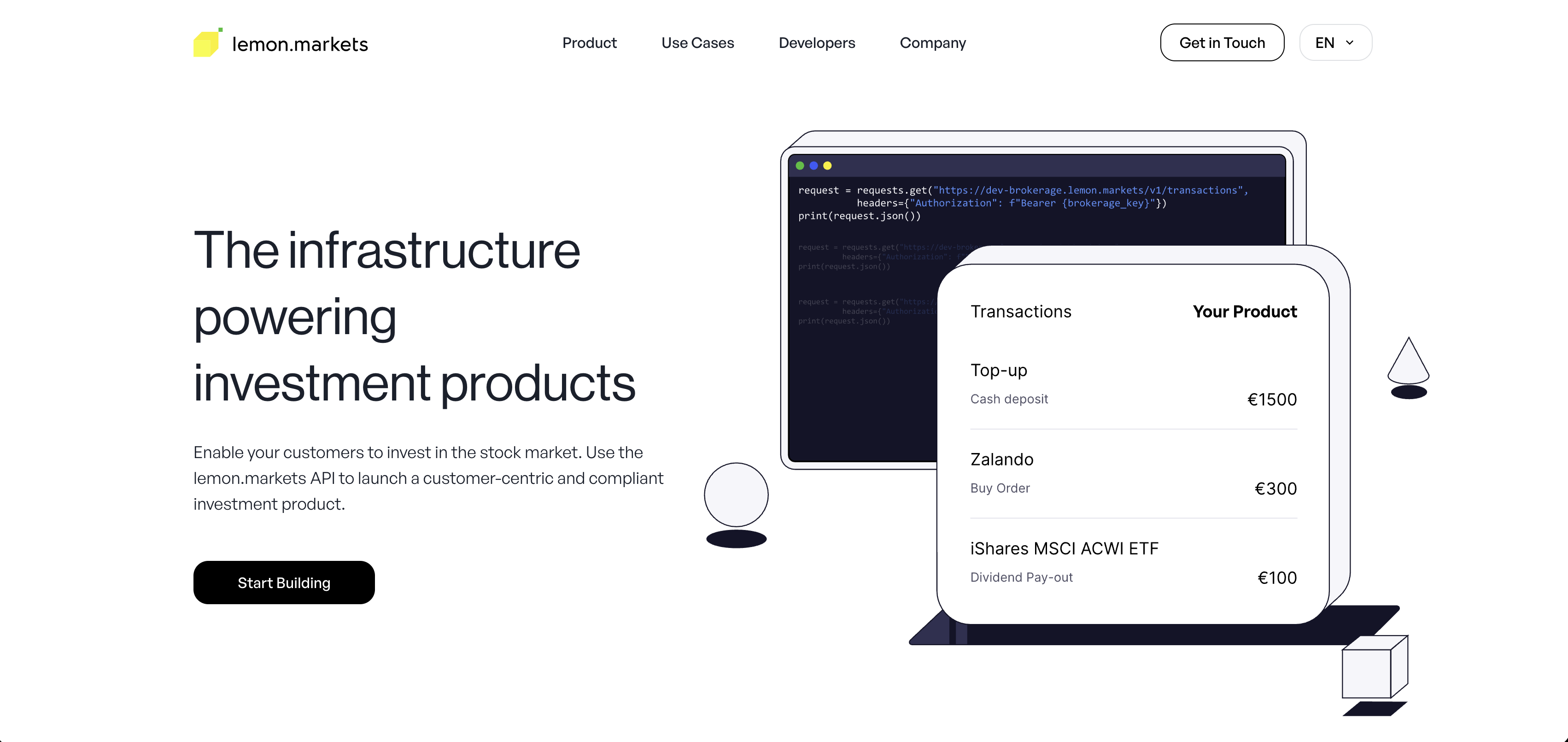
Lemon Markets is a Berlin-based fintech infrastructure platform that has stripped away the complexity of building investment services. Rather than forcing startups and established companies to navigate the labyrinth of European financial regulation and fragmented market access, Lemon Markets provides a modern, API-first foundation for trading, investing, and wealth management applications. The platform essentially democratizes access to European capital markets infrastructure that was previously locked behind expensive integrations and legacy banking relationships.
At its core, Lemon Markets connects to European stock exchanges, clearing houses, and settlement systems through a single, developer-friendly interface. This means a fintech founder can build an investment app without needing to spend months on regulatory approvals or integration nightmares. The company handles the hard infrastructure problems—market data, order routing, settlement, custody—so its clients can focus on user experience and product differentiation.
What sets Lemon Markets apart is its unabashedly technical approach. This isn't a white-label solution dressed up with templates; it's engineering-first infrastructure designed for developers. The platform has gained traction among neo-brokers, robo-advisors, and wealth management platforms across Europe, particularly in Germany, France, and beyond. It occupies a critical middle ground: more flexible and modern than legacy market infrastructure, more affordable and specialized than building everything from scratch or licensing Bloomberg terminals.
In the broader European fintech landscape, Lemon Markets represents a specific bet: that the next wave of investment apps won't be built by reinventing market infrastructure, but by companies that abstract it away entirely. As retail investing and fractional ownership become mainstream expectations, Lemon Markets sits at the plumbing layer that makes this possible.
Founded 2019
CRX Markets
SME Finance🇩🇪 Germany
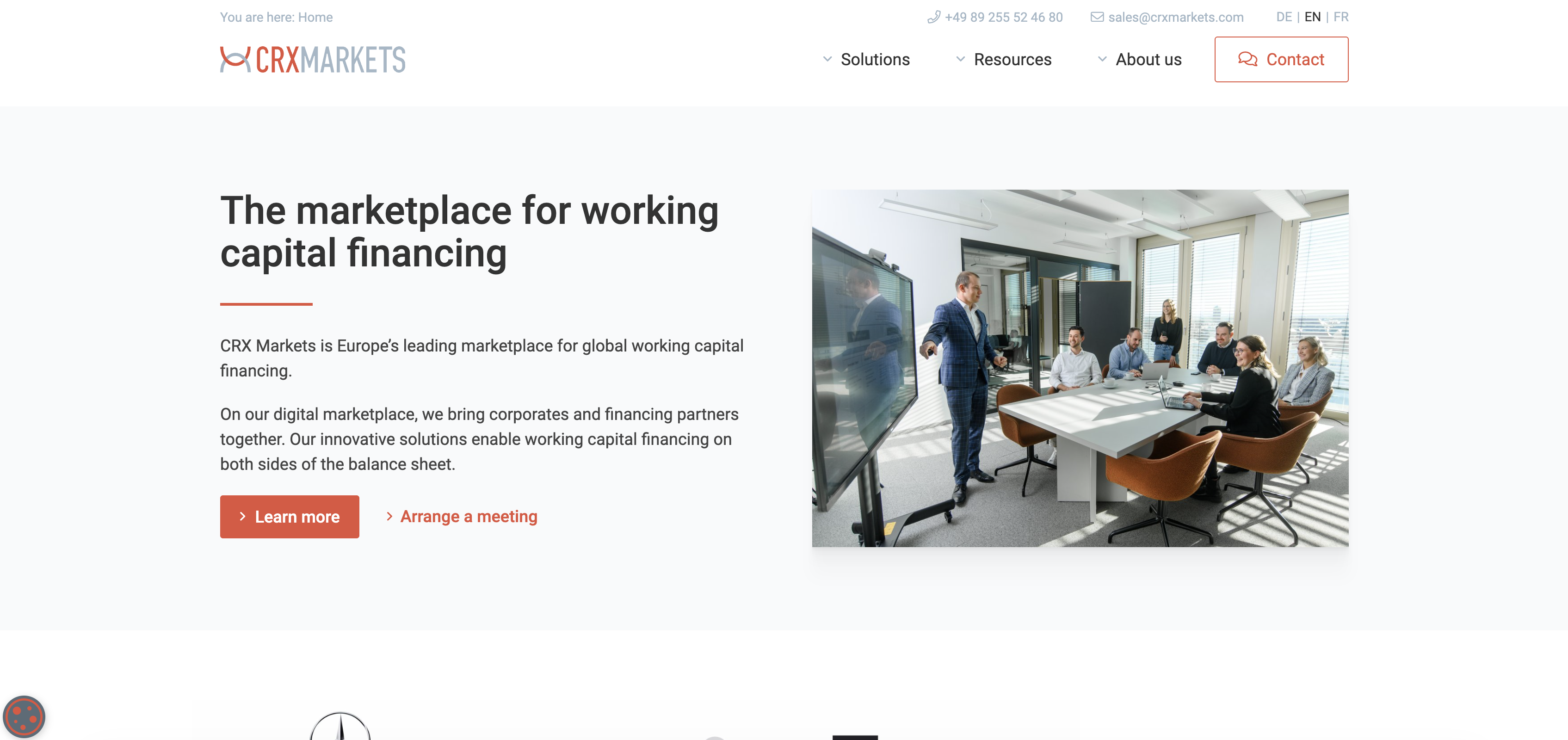
CRX Markets was founded in 2012 in Munich and set out to fix a problem every large company knows well: waiting 60 or 90 days to get paid on an invoice, while suppliers further down the chain wait even longer.
The tools are receivables finance and reverse factoring — selling an outstanding invoice to a bank or investor at a discount for cash today instead of at maturity. Neither technique is new; what CRX built is the marketplace layer around them, an automated platform connecting corporates to a network of more than 50 banks, institutional investors, and factoring companies, so that payables and receivables financing gets priced competitively instead of negotiated bank by bank.
The volumes are now substantial for a company most people outside corporate treasury departments have never heard of: more than EUR 2 billion in financing volume moves through the platform every month, cumulative volume has passed EUR 20 billion since launch, and the marketplace runs in more than 60 countries. CRX has also pushed into Sustainable Supply Chain Finance, tying supplier financing terms to ESG performance, and partnered with the IFC in 2025 to extend that model into emerging-market supply chains.
CRX is not a bank or a payments company — it is working-capital plumbing, the kind of infrastructure that keeps large buyer-supplier relationships liquid and that nobody notices until it is gone.
Founded 2012