← All services



24 European companies
FX Management Providers in Europe
FX management platforms help businesses that operate across currencies understand, hedge, and reduce their foreign exchange exposure. Companies invoicing in different currencies to their cost base face FX risk that can significantly affect margins. FX management tools provide exposure tracking, hedging analytics, and execution of forward contracts and options to lock in exchange rates for future currency requirements.
Typically offered by
European fintech companies offering FX management
Zepz
Payments🇬🇧 United Kingdom
Ismail Ahmed spent years as a compliance advisor to the United Nations Development Programme working on remittances, which meant he understood better than almost anyone what the industry cost the people using it — and that the cost fell hardest on migrants sending money to the countries least able to absorb the loss. He founded WorldRemit in London in 2010 with Catherine Wines and Richard Igoe to move that transaction online, cutting out the cash-agent networks that had defined remittances since Western Union.
The company today is a group rather than a brand. WorldRemit acquired Sendwave — a mobile-first remittance company focused on transfers to African and Asian mobile wallets, founded in 2014 by Drew Durbin and Lincoln Quirk — and reorganised in 2021 under the Zepz parent, with both brands operating separately. Combined, they serve more than 11 million customers, send from around 50 countries to more than 130, and operate over 5,000 transfer corridors. Both are fully digital on the sending side; on the receiving end, money lands in bank accounts, mobile wallets, or for cash pickup, depending on what the corridor supports.
The financial history is more turbulent than the mission suggests, and an honest profile has to include it. Zepz was valued at $5 billion in an August 2021 round of $292 million led by Accel. A planned US listing at up to $6 billion was shelved in 2022 while the company resolved what it described as accounting difficulties, amid senior management turnover. Three rounds of layoffs followed — 420 people (26% of staff) in 2023, a smaller round later that year, and around 200 more in early 2025 as it closed operations in Poland and elsewhere. Mark Lenhard, formerly COO of Bill.com, has led the group since 2022, with Ahmed remaining as non-executive chairman. Capital has continued to arrive: $267 million in a Series F in October 2024 led by Accel with LeapFrog, TCV and the IFC, and $165 million in growth financing from HSBC Innovation Banking in April 2025.
The strategic position is genuinely valuable and genuinely difficult. Digital remittances serve a market of enormous social importance — global remittance flows exceed development aid by a wide margin — with structurally thin margins, heavy compliance costs in exactly the corridors that matter most, and competition from both incumbents like Western Union and newer entrants including Wise, Remitly and LemFi. Zepz reached profitability in 2022 and has spent the years since removing the cost duplication that the WorldRemit–Sendwave combination created. Whether the $5 billion mark from 2021 bears any relation to what the business is worth today is unknown; no round since has published a valuation.
Founded 2010
Kyriba
Treasury🇫🇷 France
Kyriba is a cloud-native treasury and finance platform that sits at the intersection of corporate finance operations and intelligent automation. Rather than patching together spreadsheets and legacy systems, Kyriba consolidates cash management, liquidity forecasting, and working capital visibility into a single operating system for finance teams. Think of it as the command center for CFOs who are tired of fragmented data and manual workflows.
The platform handles everything from multi-currency cash positioning to FX hedging and supply chain financing, all orchestrated through APIs that plug into banks and accounting systems. It's built for mid-market to enterprise companies that move serious money across borders and need to know exactly where every dollar sits at any given moment. Kyriba doesn't try to be a banker or a startup darling—it's an industrial-grade tool that speaks the language of corporate treasurers.
In the European treasury space, Kyriba competes with legacy software vendors but with a modern cloud architecture that actually scales. It's the kind of platform that gets adopted quietly but becomes mission-critical once companies realize how much time their finance teams get back. The market for treasury automation remains sticky and consolidating, but Kyriba has built a defensible position by solving the unglamorous but essential work of helping large corporations optimize their balance sheets and reduce financial risk.
Founded 2000
Salv
Treasury🇪🇪 Estonia
Salv is a European treasury and payments platform designed for the modern finance team. Rather than juggling spreadsheets and legacy banking interfaces, Salv consolidates cash visibility, liquidity forecasting, and cross-border payments into a single, intuitive interface. The platform connects directly to a company's bank accounts—whether across Europe or globally—and gives CFOs and controllers real-time insight into cash positions, pending transactions, and upcoming obligations.
What sets Salv apart is its focus on simplicity without sacrificing depth. While enterprise treasury software often demands armies of consultants and months of implementation, Salv gets finance teams operational in days. The platform handles multi-currency cash management, automates reconciliation, and streamlines payment execution—all critical functions that most midmarket companies currently manage through error-prone manual processes or expensive legacy systems.
In a market dominated by entrenched enterprise players like Kyriba and Treasurit, Salv targets the overlooked middle: growth companies and mid-sized enterprises that have outgrown basic banking but don't need Fortune 500-grade complexity. It's positioned as the cash management tool for teams that want control without the headache, and it reflects a broader European fintech trend toward pragmatic, cloud-native alternatives to traditional treasury solutions. For finance leaders tired of workarounds, Salv represents the kind of infrastructure redesign that turns scattered processes into streamlined workflow.
Founded 2021
ION Group
Financial Infrastructure🇬🇧 United Kingdom
Andrea Pignataro founded ION in London in 1999, after leaving a trading role at Salomon Brothers with a conviction that the software running global markets was held together with too much manual process. Over the following two and a half decades he built ION into one of the largest, most acquisitive players in capital-markets technology — absorbing dozens of specialist vendors, including Fidessa and Broadway Technology, and folding them into a single group.
The core business is still the unglamorous plumbing of institutional finance: trading platforms across equities, fixed income, foreign exchange, and cleared derivatives; risk management; post-trade processing; clearing and settlement; and market data. Investment banks, hedge funds, and corporate treasuries run parts of their daily operations on ION's systems, often without their own customers ever knowing it.
Less visible is ION's regulatory technology line. Products including ION LookOut and Fidessa Surveillance handle trade surveillance, market-abuse detection, and regulatory reporting across multiple jurisdictions, and ION's compliance tools have placed in FinTech Global's RegTech 100 list for three consecutive years. It's a smaller part of the business than the trading and post-trade platforms, but a genuine one — which is why ION appears under both Capital Markets and RegTech in this directory, rather than just one.
The company is headquartered in London, employs more than 13,000 people across over 50 offices worldwide, and remains privately held under Pignataro's control — a scale most consumer-facing fintechs never approach, built almost entirely on customers who are themselves in finance.
Founded 1999
Small World FS
Payments🇬🇧 United Kingdom
Remittances are one of the most economically important payment categories in the world — hundreds of billions of pounds flow annually from migrants in wealthy countries to family members in their countries of origin. The market has historically been dominated by Western Union and MoneyGram, both of which extract significant fees from the people least able to afford them. Small World Financial Services was founded in London in 2005 to compete in that market with a model focused on competitive pricing and trusted local distribution in the receiving countries. Its network covers over 90 countries with a combination of bank deposits, mobile wallet delivery, and physical cash pickup options that match how recipients actually want to receive funds — particularly important in markets where bank account penetration is low but mobile wallets are universal. Small World has built a particular following among the African and Latin American diaspora communities in Europe, segments that traditional banks serve poorly and that need the trust of a specialised remittance provider. In the European remittance market, where Wise and Remitly compete aggressively, Small World's depth in specific corridors and its dual physical and digital distribution remain genuine differentiators for the customer segments where physical pickup remains essential.
Founded 2005
Paynetics
Embedded Finance🇧🇬 Bulgaria
Paynetics operates at the intersection of payment infrastructure and embedded finance, building the plumbing that lets fintechs and traditional companies accept, process, and manage payments without wrestling with legacy banking systems. The Bulgarian-founded company has positioned itself as a critical middleware layer—connecting merchants, fintech platforms, and financial institutions through a unified API. Rather than forcing clients into proprietary ecosystems, Paynetics emphasizes flexibility and interoperability, allowing partners to plug into multiple acquiring networks, payment gateways, and settlement rails from a single integration point. This approach has resonated particularly with regional players across Europe seeking alternatives to Western-dominated payment processors.
The company's strength lies not in flashy consumer-facing products but in unglamorous, essential infrastructure: payment orchestration that routes transactions intelligently, card issuing APIs that power embedded finance plays, and acquiring services that work across markets where local nuance matters. For fintech founders building in Central and Eastern Europe or scaling across fragmented European payment corridors, Paynetics removes the friction of navigating dozens of local processors and compliance regimes. Its expansion into treasury and FX services suggests ambitions beyond pure payments—positioning itself as a platform for companies managing cross-border complexity. In an industry dominated by American giants and large European incumbents, Paynetics represents a rare example of a challenger emerging from the region's underestimated fintech ecosystem, proving that critical infrastructure doesn't always require Silicon Valley pedigree.
Founded 2013
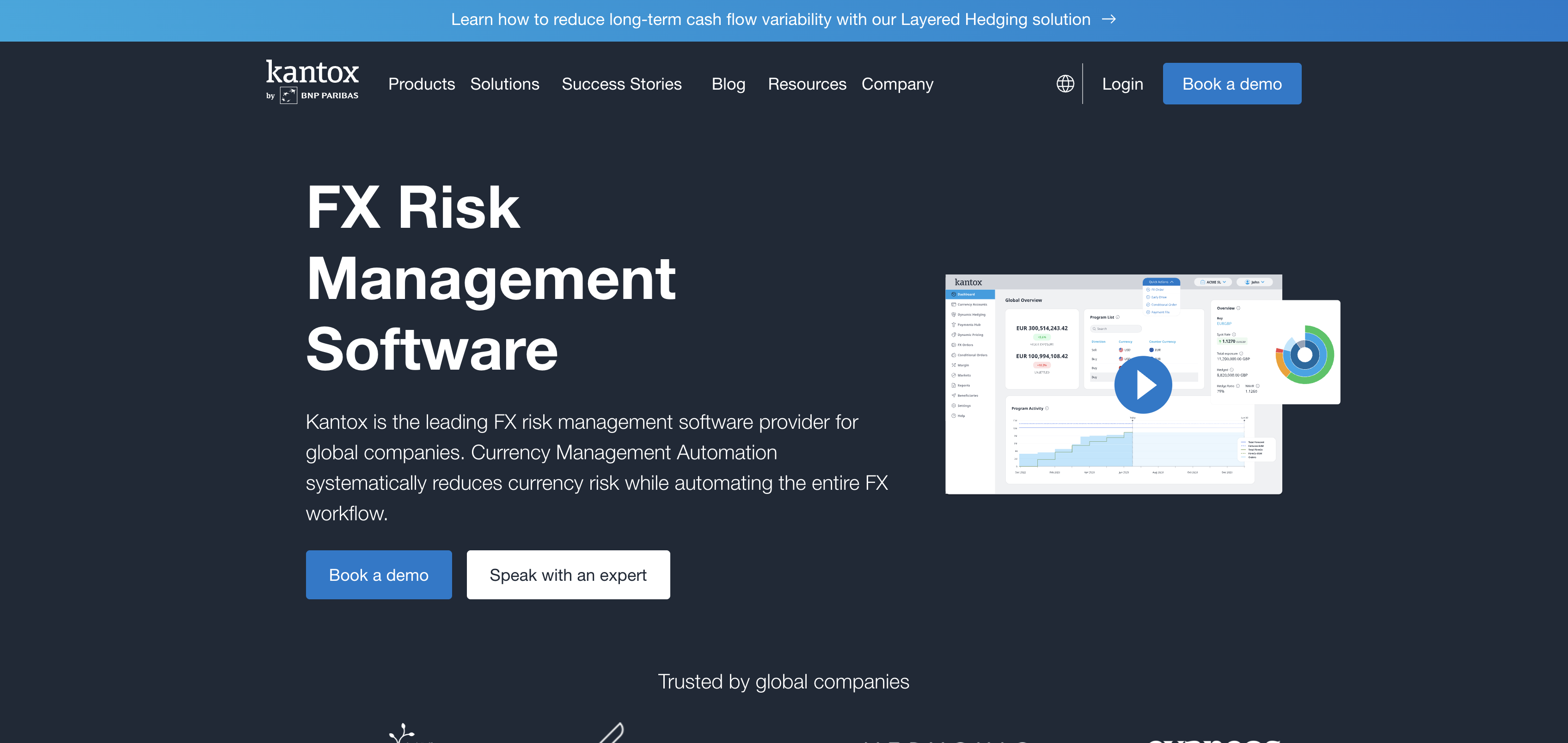
Kantox
Payments🇪🇸 Spain
Kantox sits at the intersection of corporate finance and fintech, solving a problem that has plagued treasurers and CFOs for decades: the cost and complexity of managing foreign exchange. Rather than forcing companies through the byzantine world of traditional banks or crude hedging tools, Kantox built a platform that lets businesses buy and sell currency with transparency, speed, and intelligence.
The platform aggregates liquidity from multiple sources—banks, non-bank liquidity providers, and peer matching—and surfaces the best rates in real time. No more vendor lock-in, no more opaque spreads, no more waiting. A mid-market company can execute a multi-million euro FX trade in minutes, seeing exactly what they're paying and why.
What sets Kantox apart in a crowded treasury tech space is its refusal to abstract away the mechanics. The platform shows you the market, then lets you trade. It's designed for finance professionals who know what they're doing and want control back from intermediaries. The company has built serious depth in emerging markets and supply chain currencies, which most legacy providers still treat as afterthoughts.
Kantox represents a broader shift in European fintech: the recognition that some of the most valuable problems live in the unglamorous corners of corporate finance, where even small improvements in execution cost save companies millions annually. In that sense, it's doing for FX what more visible fintechs have done for payments—stripping away friction and opacity from a process that should have been digital decades ago.
Founded 2009
Currency Cloud
Financial Infrastructure🇬🇧 United Kingdom
Currency Cloud powers cross-border payments for fintechs, banks, and platforms that move money internationally. Rather than building payment rails from scratch, companies plug into Currency Cloud's infrastructure to send, receive, and manage multi-currency transactions at scale. The platform handles the compliance complexity, FX pricing, and settlement logistics that make global payments so difficult.
What sets Currency Cloud apart is its positioning as the backbone rather than the front-end. While fintech darlings grab headlines with sleek consumer apps, Currency Cloud quietly powers payments behind the scenes for hundreds of financial services companies across Europe, Asia, and beyond. The company works with everyone from neobanks to traditional institutions to embedded finance platforms, letting them offer international payments without the headache of building their own infrastructure.
The European fintech scene has become increasingly reliant on infrastructure layers like this one—companies that solve the hard infrastructure problems so others can focus on customer experience and product innovation. Currency Cloud sits in that crucial middle tier, handling the pipes while others decorate the storefronts. It's a less visible kind of power, but arguably more fundamental to how modern fintech works.
Founded 2012
Ophen Technologies
SME Finance🇩🇪 Germany
Most corporate treasuries are still wrestling with spreadsheets and manual workflows when it comes to managing liquidity and FX exposure. Ophen Technologies reimagines treasury management for mid-market companies by building a unified platform that turns fragmented banking relationships into a single source of truth. The platform aggregates real-time cash positions across multiple banks, surfaces FX exposure, and automates the mechanics of moving money and hedging risk. It sits between a company's existing bank accounts and ERP systems, orchestrating what should be simple but somehow remains chaotic. What sets Ophen apart is its refusal to force clients into rip-and-replace dynamics. Instead, it works with existing infrastructure, meaning finance teams get immediate value without betting the company on a migration. The platform speaks the language of CFOs and controllers, not engineers, which matters when the problem you're solving is as mission-critical as knowing where your cash actually is. In a market where treasury tech tends toward either complexity or oversimplification, Ophen occupies a pragmatic middle ground. For European mid-market companies managing multi-currency operations and the complexity that comes with it, the platform addresses a genuine pain point that traditional banking and generic ERP modules have consistently underserved.
Founded 2021
Zen.com
Payments🇵🇱 Poland
The European EMI licence has been the foundation of multiple multi-currency banking platforms, and Zen.com is one of the more recent entrants to that category. Founded in Warsaw in 2018, Zen received an EMI licence and has built a digital banking platform offering multi-currency accounts, payment cards, and the cross-border financial services that a generation of European consumers and small businesses have come to expect from app-first banking products. The product range covers the standard digital wallet capabilities — multi-currency accounts in major and minor European currencies, virtual and physical cards, P2P transfers — alongside merchant payment acceptance for businesses operating internationally. The Polish base reflects both Warsaw's growing position in European fintech and the broader pattern of Central European fintechs leveraging EMI licences to operate Pan-European products from regulatory home bases that suit their operational structure. Zen has expanded its user base across European markets, building positions among consumers and small businesses needing the cross-border banking capability that has defined the European fintech consumer category over the past decade. In the European multi-currency banking landscape, where Wise, Revolut, and Monzo operate at substantially larger scales, the regional EMI operators compete on different axes — local market depth, specific feature combinations, and the willingness to serve customer segments that the major platforms do not prioritise.
Founded 2018
Fyorin
Financial Infrastructure🇲🇹 Malta
Fyorin is a European treasury and payments platform built for the modern corporate finance team. It bundles cash management, FX execution, and liquidity forecasting into a single interface—stripping away the complexity that haunts traditional treasury software. The platform connects directly to your banks and accounting systems, giving finance teams real-time visibility into cash positions across multiple accounts and currencies. Unlike legacy solutions that require armies of integrators and months of implementation, Fyorin is designed for immediate deployment, letting companies start optimizing cash flow within weeks rather than years. It appeals to mid-market and enterprise finance teams tired of spreadsheet-driven processes and fragmented point solutions. Fyorin sits squarely in the gap between enterprise banking software and modern fintech: it's professional enough for serious corporate finance, but built with the simplicity and speed that modern teams expect. The platform is particularly valuable for companies with multi-currency exposure or complex banking relationships, where manual cash management becomes a real drag on working capital efficiency. In a market crowded with legacy treasury vendors, Fyorin represents a cleaner, faster alternative that doesn't ask you to overhaul your entire finance stack.
Neteller
Payments🇬🇧 United Kingdom
Neteller is a digital payments platform that lets you move money across borders and manage funds with the speed of a startup and the infrastructure of an established player. Born in the early days of online payments, it's evolved into a multi-currency wallet and transfer service that appeals to freelancers, remote workers, and anyone tired of waiting five days for a bank wire. The platform handles card payments, money transfers, and currency exchange without the theatrical overhead of traditional banking. Where most incumbents still treat international transfers like a bureaucratic ordeal, Neteller compresses the friction—you can fund accounts, withdraw to cards, and send money globally from a mobile app.
It's part of the Paysafe group, which means institutional backing without the institutional slowness. For users in emerging markets or anyone juggling multiple currencies for work, Neteller represents the pragmatic middle ground between crypto's volatility and banks' glacial timelines. It's not revolutionary, but it's genuinely useful for the people who need it most.
Founded 1999
Showing 12 of 24 companies. View all in the directory →