← All services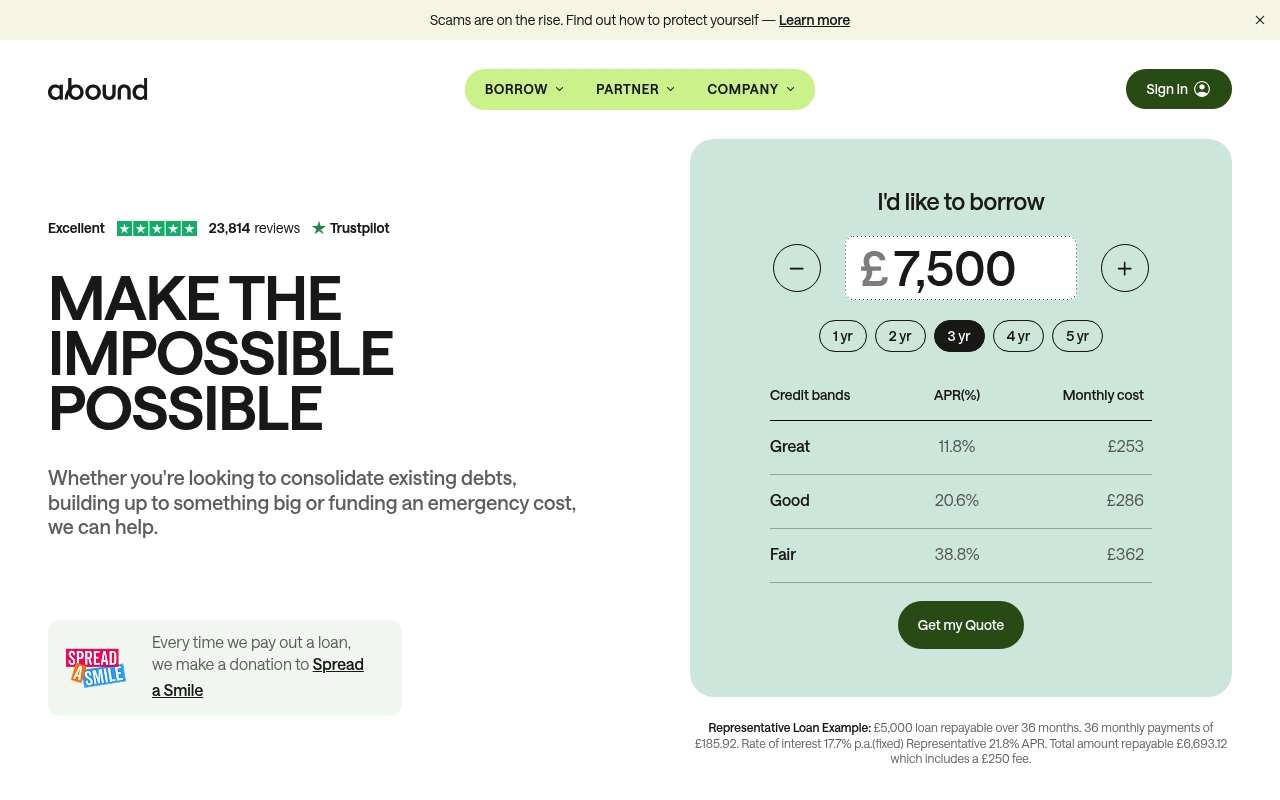




13 European companies
Loan Origination Providers in Europe
Loan origination platforms manage the end-to-end process of creating a new loan — from initial application and credit assessment through underwriting, approval, documentation, and disbursement. Digital loan origination has compressed timelines from weeks to hours for many loan types by automating data collection, credit decisioning, and document generation, while maintaining the compliance standards that regulated lending requires.
Typically offered by
European fintech companies offering loan origination
Abound
Open Banking🇬🇧 United Kingdom
Gerald Chappell ran digital lending globally at McKinsey; Dr Michelle He was a director at EY advising banks on credit analytics, with a PhD in computer science. Both spent years building credit products for large financial institutions, and both reached the same conclusion about the machinery they were working inside: it was wrong at the individual level. A credit score is a statistical average applied to a person — it captures how someone has borrowed before, not what they can actually afford now. In 2020 they founded Fintern in London to replace that inference with observation, using the bank transaction data PSD2 had just made accessible. Chappell's description of what open banking gives a lender is the sharpest summary of the thesis: financial X-rays.
The consumer product, rebranded from Fintern to Abound, is a UK personal loan of a few thousand pounds up to around £20,000, repayable over one to five years, applied for entirely online with funds arriving within hours of approval. What happens underneath is the actual product. Applicants connect their bank accounts through open banking; Abound's proprietary platform, Render, reads real income and real spending — the rent, the subscriptions, the irregular gig income, the seasonal dip — and calculates affordability from what is there rather than from a bureau file. A soft credit check runs alongside it, so quoted rates carry no credit-score impact. The practical consequence is that people with thin files or a couple of historic blemishes can be approved on evidence a scorecard would never see, and that the company claims default rates roughly 75% below industry standard. That figure is Abound's own and unaudited — but the direction is corroborated by the funding it has been able to raise against the loan book.
That funding is the second thing to understand precisely. Abound has announced facilities totalling more than £1.6 billion since launch — £500 million in 2023, up to £800 million in 2024, a further £250 million from Deutsche Bank in 2025 — from Citi, Deutsche Bank, Waterfall Asset Management, LuminArx, Salica, Informed Ventures, and West Coast Capital. The overwhelming majority is debt to fund lending, not equity in the company; before the 2023 round Abound had raised only around $11 million in equity, and no valuation has ever been disclosed. This is the standard structure for a balance-sheet lender and it says something real — institutional lenders underwrite the underwriter, and £1.6 billion of credit facilities is a market verdict on Render's models — but it is not a $1.6 billion company. The genuinely notable milestone is quieter: Abound reached profitability three years after launch, and has now lent over £1 billion, from a team of roughly 130 in London.
The strategic shape now mirrors what several European fintechs have converged on: run the consumer brand, and rent the machinery. Render is being licensed to other lenders — GAIA Family and LemFi are named clients — as cashflow underwriting infrastructure for companies that want to launch credit products or improve their decisioning without building affordability models themselves. Alongside it sit partner products in retail finance and premium finance. It is the same dual model that made Klarna infrastructure for Apple: the consumer business proves the technology, and the technology business scales beyond what the consumer brand could reach alone. International expansion has been signalled repeatedly but Abound remains UK-only, regulated by the FCA under Fintern Ltd (FRN 929244).
The honest read requires looking at the rate card. Abound markets fairness, and relative to what its customers' alternatives are, the case is strong: representative APR is 21.8%, debt consolidation customers save around £1,000 over a loan's life on the company's numbers, and 25,000-plus Trustpilot reviews average 4.9 — unusually good for consumer credit, a category where people rarely leave happy reviews. But the published bands run from 11.8% for the strongest applicants to 38.8% for the "fair" band, and the sample £5,000 loan carries a £250 fee. This is near-prime and non-prime lending: much cheaper than payday or doorstep credit, considerably more expensive than a high-street personal loan, and priced for a customer the high street declines. The structural question is the one facing every lender that has only grown — Abound's models have been profitable through a rate shock but not yet through a genuine consumer credit downturn, and affordability underwriting is precisely the discipline that either proves itself or doesn't when unemployment moves. What it has already demonstrated is narrower but not trivial: open banking data, six years after PSD2 made it available, can underwrite people the credit bureaus get wrong.
Founded 2020
Mambu
Financial Infrastructure🇩🇪 Germany
Mambu is a cloud-native banking software platform that lets financial institutions and fintechs launch and operate lending and deposit products without building from scratch. Rather than forcing customers into rigid legacy systems, Mambu provides composable banking infrastructure—modular APIs and pre-built components that work together or stand alone, depending on what you actually need.
The company sits at the intersection of two fintech realities: traditional banks are drowning in outdated core systems that can't keep pace with market demands, while new lenders and neobanks need speed without sacrificing compliance or scale. Mambu's approach is to be the operating system underneath, handling the heavy lifting of loan origination, deposit management, portfolio servicing, and regulatory reporting while letting clients focus on customer experience and product innovation.
What makes Mambu different from other core banking platforms is its emphasis on velocity. Institutions deploy in weeks rather than years. The platform is genuinely modular—you can pick the lending module, the deposit module, or both, and layer in third-party services through APIs. This flexibility has resonated with everyone from African microfinance networks to European challenger banks to enterprise lenders managing complex credit products.
Mambu is now a critical piece of infrastructure in the emerging markets fintech ecosystem, particularly across Africa and Asia, where it powers lending operations for hundreds of financial institutions. In Europe, it's carved out space among mid-market and challenger banks looking to avoid the capital expenditure and technical debt of legacy systems. The company represents a broader shift in fintech: away from end-to-end platforms that claim to do everything, toward specialized infrastructure that does one thing—backend financial operations—exceptionally well.
Founded 2011
Narvi
Embedded Finance🇫🇮 Finland
Narvi is a European fintech that simplifies embedded lending for e-commerce and marketplace platforms. Rather than forcing merchants to build lending infrastructure from scratch, Narvi handles the entire loan lifecycle—from origination through servicing—as a white-label API that integrates directly into checkout flows.
The company targets online retailers and marketplace operators who want to offer buy-now-pay-later and installment credit without the operational overhead of underwriting, collections, or compliance. Narvi handles credit decisions using proprietary scoring models and manages all regulatory requirements, while merchants simply embed a widget and capture incremental revenue.
In a market crowded with point-solution BNPL providers, Narvi positions itself as a full-stack lending partner rather than a payment mode. The company serves merchants across Europe and has built integrations with major e-commerce platforms, making it simpler for smaller retailers to compete with well-funded rivals on financing offerings.
Narvi represents a growing class of embedded finance infrastructure plays—companies enabling non-financial businesses to offer financial products without becoming financial institutions themselves. Its role is to abstract complexity and regulatory burden, letting merchants focus on customer experience and growth.
Founded 2020
Enity
Embedded Finance🇩🇪 Germany
Enity sits at the intersection of embedded finance and merchant payments, letting businesses embed lending directly into their checkout flows. Rather than forcing customers to apply for credit elsewhere, Enity's API lets companies offer point-of-sale financing instantly—think Buy Now, Pay Later but more flexible and customizable. The platform handles underwriting, decisioning, and funding, meaning merchants don't carry the credit risk themselves. It's the kind of infrastructure that makes sense as e-commerce and marketplaces mature beyond simple transaction processing. Enity works across Europe, tapping into fragmented credit markets where unified APIs for embedded finance remain rare. The company positions itself against both traditional BNPL providers—which often dictate terms to merchants—and against the friction of integrating multiple lenders. Its real edge is speed and developer experience: getting live takes days, not months. For merchants handling high-value transactions or B2B sales, Enity's underwriting engine and multi-lender orchestration solve a genuine pain point. The rise of embedded lending means platforms like this will become table stakes for any serious commerce infrastructure player.
Founded 2020
Klear Lending
Lending🇧🇬 Bulgaria
Klear Lending is a London-based fintech that automates credit decisions for alternative lenders and financial institutions across Europe. The company has built a machine learning platform that cuts through the complexity of underwriting—replacing outdated credit scoring with algorithmic assessment that learns from lender-specific data and performance patterns. Rather than forcing institutions into rigid scoring boxes, Klear's technology adapts to how different lenders actually price risk, meaning a borrower rejected by one algorithm might be approved by another using the same underlying data.
The platform processes loan applications in seconds, reducing the manual review work that traditionally chokes alternative lending operations. Its clients range from peer-to-peer platforms and buy-now-pay-later startups to traditional bank-owned lending divisions looking to modernize their decision engines. Klear sits at the intersection of infrastructure and risk—not quite a lender itself, but the invisible scoring layer that powers decisions across Europe's fragmented credit market.
In a landscape where underwriting talent is expensive and credit models age quickly, Klear's bet is that dynamic, data-driven decisioning will eventually become table stakes for any lender serious about competitive underwriting. The company has steadily built a niche serving institutions that can't build these capabilities themselves but can't afford to leave money on the table with overly conservative approval rates either.
Founded 2016
Finloup
Financial Infrastructure🇬🇷 Greece
Finloup is a European lending infrastructure platform that helps financial institutions and fintechs automate credit decisions and manage loan portfolios at scale. The company builds white-label software that sits between lenders and borrowers, handling everything from application to origination to ongoing portfolio management. Rather than reinventing the wheel for each lender, Finloup abstracts away the operational complexity of modern lending—think of it as the backstage machinery that lets banks and fintech lenders focus on distribution and customer experience instead of building lending systems from scratch. The platform works across consumer and SME lending, serving institutions across multiple European markets who need faster, smarter, more compliant ways to originate and manage credit. Where traditional core banking systems move slowly and cost millions to customize, Finloup offers speed and flexibility. It's built for a market where fintech lending has exploded but the infrastructure hasn't kept pace with demand. The company essentially democratizes access to institutional-grade lending technology, lowering the barriers for smaller players to compete with incumbents. Within the broader fintech ecosystem, Finloup represents a critical infrastructure layer—the unsexy but essential plumbing that makes modern lending possible at European scale.
Founded 2019
Lenvi
Real Estate Finance🇬🇧 United Kingdom
Lenvi is a European proptech lender that specializes in financing for residential real estate professionals and investors. The platform cuts through the friction of traditional mortgage underwriting by automating credit decisions for property developers, house flippers, and buy-to-let investors who operate at speed and don't fit neatly into conventional banking boxes.
The company targets borrowers who need capital quickly—think property professionals funding renovations or acquiring new stock—and offers them streamlined, data-driven lending decisions instead of the opaque bureaucracy of high street banks. Lenvi's underwriting combines automated scoring with rapid turnaround, letting borrowers close deals while competitors are still gathering paperwork.
In a market where most lenders still favor pristine employment histories and predictable income profiles, Lenvi has built its underwriting around property-specific metrics: project value, equity position, asset-backed security. This positioning matters because it reflects a fundamental shift in how fintech approaches risk—not as static credit scores, but as dynamic, transaction-specific assessments.
Lenvi sits at the intersection of proptech and fintech, bridging the gap between traditional real estate finance and the speed-obsessed dynamics of modern property markets. For borrowers tired of 8-week mortgage timelines, it represents a genuinely different approach to real estate lending across Europe.
Founded 2021
Finastra
Financial Infrastructure🇬🇧 United Kingdom
Finastra is a London-based financial software giant that powers the plumbing behind modern finance. Rather than chasing consumers with flashy apps, Finastra builds the invisible infrastructure that banks, investment firms, and capital markets players depend on to operate. Think of it as the operating system for institutional finance—the sort of company most people have never heard of but whose systems process trillions in transactions daily.
The company's portfolio spans core banking systems, treasury management platforms, capital markets solutions, and lending technology. Finastra operates at the intersection of legacy finance and digital transformation, helping traditional institutions modernize their backend without scrapping decades of accumulated complexity. For banks and brokers, Finastra's software is often indispensable—the kind of vendor you can't easily replace once integrated into your operations.
In the European market, Finastra competes with other heavyweight infrastructure players but stands out for its broad coverage across retail, corporate, and capital markets segments. The company has grown partly through acquisition, absorbing competitors and bolt-on technologies to expand its ecosystem. It's not the startup disrupting finance from the margins; it's the entrenched platform that established institutions lean on to survive and scale.
Founded 2008
MiFin
Lending🇸🇰 Slovakia
MiFin is a machine learning platform built for the realities of alternative finance. Rather than forcing lenders into rigid credit scoring models designed for prime borrowers, MiFin works backward from actual lending performance—building custom risk algorithms that reflect real portfolio behavior. The platform ingests historical loan data and market conditions to generate underwriting rules that scale, whether you're lending to gig workers, small merchants, or emerging market entrepreneurs. It's the kind of infrastructure that lets alternative lenders compete on speed and accuracy without building everything from scratch. Where traditional risk models assume stability, MiFin expects volatility and prices for it. The platform serves lenders who operate at the edges of the conventional credit system—the segments where standard scorecards fail and data-driven judgment becomes competitive advantage. MiFin sits at the intersection of fintech infrastructure and alternative finance, solving a very specific problem: how do you automate credit decisions when your borrowers don't fit into standard categories? The answer, it turns out, is to stop trying to fit them into those categories at all.
Founded 2014
Oradian
Financial Infrastructure🇭🇷 Croatia
Microfinance institutions and banks operating in emerging markets have technology needs that the major core banking platforms haven't traditionally served well — they need cloud-deployed infrastructure that runs reliably with intermittent connectivity, supports the specific products and workflows of microfinance, and is priced for institutions that operate at scale but with thinner margins than developed-market banks. Oradian was founded in Zagreb in 2012 to build that core banking platform, deploying its cloud-native banking infrastructure to microfinance institutions, credit unions, and emerging market banks across Africa, Southeast Asia, and Latin America. The Croatian engineering base combined with deep expertise in emerging market banking operations gave Oradian a positioning that few core banking competitors could replicate — modern cloud architecture combined with genuine understanding of how microfinance institutions actually work. Oradian has deployed its platform to hundreds of financial institutions across multiple emerging market regions, processing billions in transactions for institutions serving millions of customers who would otherwise be excluded from formal financial services. In the broader European fintech landscape, Oradian represents the category of European technology built explicitly for emerging market deployment — a model that has produced some of the more interesting and impactful fintech outcomes by addressing markets where the underlying need is substantial and where European technology engineering can deliver disproportionate value.
Founded 2012
Finby
Embedded Finance🇸🇰 Slovakia
Finby is a European embedded finance platform that lets businesses integrate lending, payments, and financial products directly into their applications without building infrastructure from scratch. The company strips away the complexity of launching financial services—whether you're a marketplace, e-commerce platform, or SaaS tool looking to offer credit, buy-now-pay-later, or payment solutions to your customers. Rather than forcing businesses to navigate banking partnerships and regulatory frameworks alone, Finby provides white-label APIs and integration tooling that abstract away the backend plumbing. This positions it as a bridge between traditional financial institutions and the modern software stack. Finby's approach is particularly relevant for European platforms operating across multiple jurisdictions, where regulatory compliance and cross-border payment complexity often stall financial product launches. The company competes in an increasingly crowded embedded finance space, but differentiates through deep focus on European regulatory requirements and multi-market deployment. For software companies wanting to monetize financial services without becoming fintech experts, Finby serves as an operational backbone—letting engineers ship financial features at the speed of code, not banking timelines. Its role in the broader landscape reflects the industry shift toward financial capabilities becoming commoditized infrastructure rather than proprietary moats.
Weefin
Lending🇫🇷 France
Weefin is a French fintech that helps consumers navigate the murky world of consumer credit with algorithmic precision. Rather than drowning users in confusing loan options, Weefin acts as a personal credit matchmaker, using data and AI to surface the most suitable financing products from a network of lenders. It's solving a genuine friction point: most people shopping for personal loans have no idea which option actually fits their circumstances, so they either overpay or get rejected. The company positions itself as a transparent intermediary in a market where traditional banks still treat credit like a black box. Weefin aggregates loan offers, compares terms, and guides users toward products that make financial sense for their specific situation rather than maximizing lender margins. It's the anti-payday-loan play—using technology to bring clarity to a category that thrives on confusion. The platform works with established financial institutions, making it a white-glove service for consumers who want intelligence, not just access. In a European fintech landscape crowded with neobanks and payment startups, Weefin occupies a narrower but genuinely useful niche: making consumer credit less of a gamble and more of an informed decision. It reflects a broader shift toward algorithmic transparency in lending, where the consumer's best interest and the platform's intelligence alignment create real value.
Founded 2018
Showing 12 of 13 companies. View all in the directory →