← All services


9 European companies
Token Issuance Providers in Europe
Token issuance platforms provide the infrastructure to create and distribute digital tokens on blockchain networks — representing financial assets, loyalty points, access rights, or other forms of value. Security token issuance for regulated financial instruments operates under the EU's DLT Pilot Regime. Asset tokenisation is an active area of institutional interest for the potential to reduce settlement times and increase liquidity in traditionally illiquid asset classes.
Typically offered by
European fintech companies offering token issuance
Ledger
Crypto & Blockchain🇫🇷 France
Ledger is the world's most recognizable cryptocurrency hardware wallet manufacturer, though the company has evolved well beyond that single product. Founded in 2014, it pioneered the idea that self-custody of digital assets could be both secure and user-friendly, making crypto accessible to millions who otherwise would have left their holdings on exchanges. The company operates as a full-stack crypto infrastructure provider, offering hardware wallets (Ledger Nano S and X), a software wallet platform, and developer APIs that let third-party services integrate Ledger's security model into their own products.
What sets Ledger apart in the crypto space is its obsessive focus on security through isolation. While competitors often offer software wallets or custodial solutions, Ledger's approach keeps private keys permanently offline, eliminating the attack surface that plagues hot wallets. The company has successfully maintained that zero-breach record for a decade, which matters enormously in an industry built on trust and skepticism. Beyond hardware, Ledger has quietly built a platform ecosystem—Ledger Live (the official app) aggregates portfolio tracking, staking, swaps, and third-party integrations, turning the wallet into something closer to a financial operating system for crypto natives.
Ledger operates at a fascinating intersection of consumer hardware business and B2B infrastructure play. Millions of individual users buy Ledger devices directly, but the company also licenses its technology to banks, exchanges, and other financial institutions looking to offer institutional-grade custody. It's a rare position in fintech: simultaneously a consumer brand (few non-crypto companies sell physical products as recognizable as a Ledger Nano) and an enterprise security provider. That duality has made Ledger one of Europe's most valuable fintech unicorns, though it remains private. In the broader fintech ecosystem, Ledger represents the backbone layer—the infrastructure that makes decentralized finance possible without requiring users to become security experts themselves.
Founded 2014
MoonPay
Embedded Finance🇬🇧 United Kingdom
MoonPay sits at the intersection of crypto and traditional finance, offering on and off-ramps that let people move money between their bank account and crypto wallets with minimal friction. Founded in 2018, the London-based company has quietly become one of Europe's most important infrastructure plays in the emerging crypto economy, handling billions in transactions across more than 150 countries.
What sets MoonPay apart is its unglamorous but essential positioning: it's not trying to be a crypto exchange or a trading platform. Instead, it's the plumbing layer that makes crypto accessible to ordinary people. You buy crypto through MoonPay the same way you'd buy a digital service—seamless, compliant, and fast. The company operates with full EU regulation, holding licenses across multiple jurisdictions while maintaining the kind of compliance rigor that traditional banks expect. MoonPay's API-first approach means startups, wallets, and even traditional fintech apps can embed crypto purchasing directly into their user experience. This white-label capability has attracted partnerships with everyone from music platforms to gaming studios. The company has raised substantial funding and is valued at over a billion dollars, a testament to how critical crypto infrastructure has become. In a market obsessed with trading speculation and yield farming, MoonPay represents something more fundamental: the normalization of crypto as a payment asset class. It's doing for cryptocurrency what Stripe did for online payments—removing the technical and regulatory barriers that kept it confined to specialists.
Founded 2018
Tokeny
Financial Infrastructure🇱🇺 Luxembourg
Tokeny sits at the intersection of traditional finance and blockchain, building the infrastructure for institutions to tokenize real-world assets. The company transforms illiquid holdings—real estate, private equity, bonds, commodities—into tradeable digital securities, giving wealth managers and asset owners a way to unlock capital without the friction of traditional markets.
What sets Tokeny apart is its focus on institutional credibility. Rather than chasing retail crypto excitement, the company has built compliance-first tooling that speaks the language of regulators, custodians, and fund administrators. Their platform handles the entire lifecycle: issuance, custody, trading, and settlement, all wrapped in the governance frameworks that institutional clients actually need.
The European fintech scene is crowded with blockchain evangelists; Tokeny reads differently. It's less "decentralize everything" and more "make institutional finance move at digital speed." In a market where real asset tokenization is still nascent, Tokeny occupies the pragmatic middle ground—Web3 infrastructure without the ideology.
The company is positioning itself as essential plumbing for an inevitable shift: the digitization of capital markets. As regulatory frameworks clarify across Europe, tokenization moves from proof-of-concept to production, and Tokeny's early positioning in the institutional layer could prove valuable.
Founded 2017
Finoa
Crypto & Blockchain🇩🇪 Germany
Institutional crypto custody is one of the most technically demanding and regulatory-intensive areas of the digital asset industry. Holding crypto on behalf of institutional clients — hedge funds, family offices, asset managers, corporates — requires the security infrastructure of a Swiss vault, the compliance framework of a regulated custodian, and the technical capability to support the full range of blockchain operations that institutional clients increasingly require. Finoa was founded in Berlin in 2018 to build exactly that. Its regulated custody platform serves institutional investors across Europe, offering secure storage of digital assets, staking, governance participation, and DeFi access through a compliant, regulated interface. Finoa received regulatory approval from Germany's BaFin, making it one of the first regulated institutional crypto custodians in Germany — a market where regulatory standing is a hard prerequisite for working with the institutional clients that matter most. The company has built a client base of professional investors navigating the transition from traditional to digital assets, providing the infrastructure that makes institutional crypto participation possible within existing regulatory and compliance frameworks. In the European institutional crypto landscape, Finoa occupies the regulated, conservative end of the spectrum — precisely where the most significant long-term capital flows are likely to arrive.
Founded 2018
Tatum
Financial Infrastructure🇨🇿 Czech Republic
Building blockchain applications has historically required either deep specialist expertise or working through complex direct integrations with multiple blockchain networks — a barrier that has limited the rate at which conventional software developers could adopt blockchain technology for legitimate use cases. Tatum was founded in Prague in 2017 to abstract that complexity into a simpler developer experience. Its platform provides unified APIs for building applications across multiple blockchain networks, supporting Ethereum, Bitcoin, Solana, and dozens of other chains through a consistent interface that handles wallet management, transaction signing, smart contract interaction, and the operational infrastructure that production blockchain applications require. The Czech engineering base reflects Central Europe's broader strength in technical infrastructure software, and Tatum has built a developer base across enterprises and crypto-native projects that need blockchain capability without the complexity of direct integration with each network. In the broader blockchain infrastructure landscape, the developer platform model competes with infrastructure providers like Alchemy and Infura on different competitive axes — Tatum's multi-chain unified approach addresses developers who need network breadth rather than depth in a single chain ecosystem. The category remains competitive as enterprise blockchain adoption continues evolving and as the relative importance of different blockchain networks shifts with broader market conditions.
Founded 2017
VNX
Financial Infrastructure🇱🇮 Liechtenstein
VNX is building the infrastructure layer for tokenized real assets—a platform that lets financial institutions, enterprises, and asset managers issue and manage blockchain-based representations of everything from bonds to real estate to commodities. The company operates at the intersection of traditional finance and blockchain, treating tokenization not as a speculative experiment but as a plumbing upgrade for how assets move through institutional markets.
What sets VNX apart is its focus on regulatory clarity and institutional-grade tooling. While much of crypto has fixated on trading and speculation, VNX is solving the unglamorous but essential problem: how do you actually issue, custody, settle, and report on tokenized assets in a way that satisfies regulators, auditors, and risk committees? The platform handles the full lifecycle—from issuance to lifecycle management to integration with existing settlement rails.
VNX operates in a crowded but still-nascent space. Several players are chasing tokenization, but most are either pure-play blockchain companies treating finance as an afterthought, or traditional finance incumbents moving cautiously. VNX sits in the pragmatic middle: deep respect for regulation and compliance, but genuine belief in blockchain's structural benefits for settlement speed, transparency, and cost. The platform is live and processing real assets, not just running pilots.
For European financial institutions hesitant about crypto but curious about efficiency gains, VNX represents a bridge—a way to experiment with tokenization without betting the institution on a moonshot narrative.
Founded 2021
Taurus
Financial Infrastructure🇨🇭 Switzerland
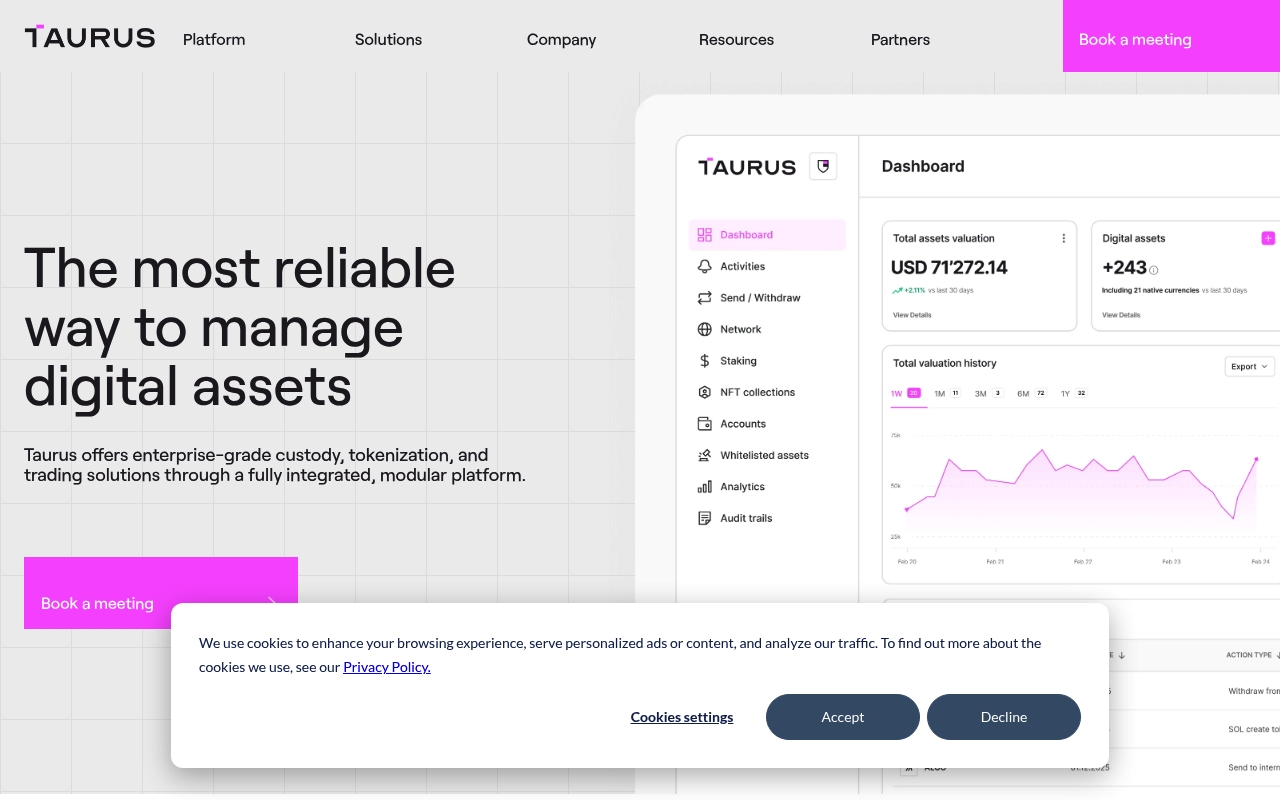
Taurus sells to the institutions that everyone else in crypto spent a decade antagonising. Founded in Geneva in 2018, it builds enterprise infrastructure for banks and financial institutions to issue, custody and trade digital assets — private key management, tokenisation, and the operational controls a regulated bank needs before it can hold a customer's bitcoin. The product is deliberately unglamorous: no exchange, no consumer app, no token. Switzerland's regulatory environment made this possible earlier than elsewhere, and Taurus was positioned when the institutional wave arrived.
The validating relationship is Deutsche Bank. Germany's largest bank invested in Taurus as part of a $65 million funding round in 2023, and has worked with it on digital asset projects since; when Deutsche Bank's long-delayed crypto custody service was reported to be targeting a 2026 launch, Taurus was named as a continuing infrastructure partner alongside Bitpanda's technology division. Taurus serves over 25 institutional clients, and its investor base and client list overlap in a way that is common in institutional infrastructure — the banks that buy the technology also fund the company building it.
The strategic position is strong and narrow. MiCA has forced every European bank considering digital assets to answer custody and compliance questions that Taurus's platform is built to answer, and the institutional shift toward tokenised assets extends the addressable market well beyond cryptocurrency into bonds, funds and structured products. The risks are the mirror image: a small number of large clients, deep dependence on institutional adoption timelines that have slipped repeatedly, and competition from both crypto-native custodians expanding upmarket and traditional custodians building in-house. Taurus is a bet that banks will keep choosing to buy this capability rather than build it — a bet that has held so far.
Founded 2018
Debitum
Wealth🇪🇪 Estonia
Debitum is a peer-to-peer lending platform that connects investors across Europe with emerging market borrowers, primarily small businesses and consumers in Africa and Southeast Asia. Rather than traditional bank intermediaries, Debitum uses blockchain technology and smart contracts to facilitate direct lending relationships, cutting out middlemen and offering investors returns typically unavailable in their home markets.
The platform operates on a marketplace model where verified borrowers access capital while European investors diversify into emerging markets at institutional-grade returns. What sets Debitum apart is its hybrid approach: it combines traditional credit underwriting with transparent, technology-enabled funding mechanics. Unlike neobanks focused on consumer checking or payment apps targeting young professionals, Debitum sits at the intersection of capital markets access and peer-to-peer finance, targeting financially sophisticated individuals seeking yield. The company tokenizes loans on its platform, allowing fractional investment and secondary market trading. Debitum represents a growing category of European fintech platforms that treat emerging markets not as charity cases but as genuine investment opportunities, democratizing access to higher-yielding assets traditionally reserved for institutional investors.
Founded 2015
Bitpanda
Embedded Finance🇦🇹 Austria
Eric Demuth, Paul Klanschek and Christian Trummer founded Bitpanda in Vienna in 2014, at a point when running a crypto business meant operating in a regulatory vacuum and most competitors treated that vacuum as an opportunity. Bitpanda treated it as a temporary condition. The strategic bet — that crypto would eventually be regulated, and that the platforms holding licences when it happened would inherit the market — took a decade to pay off, and shaped everything about how the company was built.
The product today is broader than crypto and deliberately so. A single Bitpanda login covers more than 600 cryptocurrencies in real custody, around 10,000 stocks and ETFs at a flat €1 per order since January 2026, four physical precious metals, and automated savings plans, with first purchases possible from as little as a euro. That multi-asset structure is the strategic differentiator against pure crypto exchanges: it positions Bitpanda as a general-purpose retail investment platform that happens to have started in crypto, competing as much with Trade Republic and Scalable Capital as with Coinbase. Growth has been steady rather than explosive — one million users in 2019, four million by 2023, six million by the end of 2024, and past seven million since.
The licensing record is the company's core asset. Demuth's claim that Bitpanda held more than ten licences and registrations before MiCA even existed is borne out by the sequence that followed: in January 2025 it became the first major crypto platform to receive a full MiCA licence, granted by Germany's BaFin, followed by authorisations from Malta and from Austria's own FMA in April 2025 — three regulators in three countries. Demuth was pointed at the time about the distinction between a licence with immediate validity and the "in-principle" approvals competitors were announcing. That regulatory standing also underpins a second business: Bitpanda Technology Solutions, the white-label arm that supplies infrastructure to banks, and which was reported in 2025 as a partner in Deutsche Bank's long-delayed crypto custody service alongside Taurus.
Which makes August 2026 an awkward footnote. Austria's FMA fined Bitpanda GmbH €70,000 — the first legally binding MiCA penalty the regulator has published anywhere in the EU. The breaches were procedural rather than harmful: failing to submit a crypto-asset white paper the required twenty working days before publication, circulating a marketing communication before the white paper was published, and omitting required disclosures from that communication. Bitpanda said the findings concerned timing and formal specifications rather than customer harm, that it had coordinated the process with the FMA, and that it resolved the matter quickly. The regulator, for its part, noted pointedly that being the first published MiCA case confers no special status on the firm involved. The sum is trivial for a company of this size; the significance is that MiCA has moved from licensing into enforcement, and the first published example landed on the platform that has campaigned hardest on being the most regulated in Europe.
The honest read is that Bitpanda's positioning is both genuine and commercially motivated, and that both things can be true. Building a licensed, multi-asset, retail-first platform from Vienna while competitors chased offshore jurisdictions was a real strategic choice with real costs, and MiCA has vindicated it — every crypto platform serving EU customers now needs what Bitpanda spent ten years acquiring. The open questions are ordinary ones: whether a company generating revenue in the low hundreds of millions can defend a retail market against neobrokers with banking licences moving into crypto from the other direction, and whether the reported preparations for a public listing arrive in a window that values the regulatory moat properly. Sponsorships of Arsenal and other sports properties suggest a company spending to build brand ahead of something.
Founded 2014